Home > Stainless Steel > Stainless Steel Garde > 317L Stainless Steel
317L Stainless Steel is a low-carbon, molybdenum-bearing austenitic stainless steel developed for welded equipment used in demanding chemical and industrial environments. Its higher chromium, nickel and molybdenum content generally provides better resistance to chemical attack, pitting and crevice corrosion than conventional 304L and 316L stainless steels.
The “L” designation indicates a maximum carbon content of 0.03%. This lower carbon level reduces the risk of chromium-carbide precipitation during welding and helps preserve corrosion resistance around properly welded joints without requiring post-weld solution annealing in many applications.
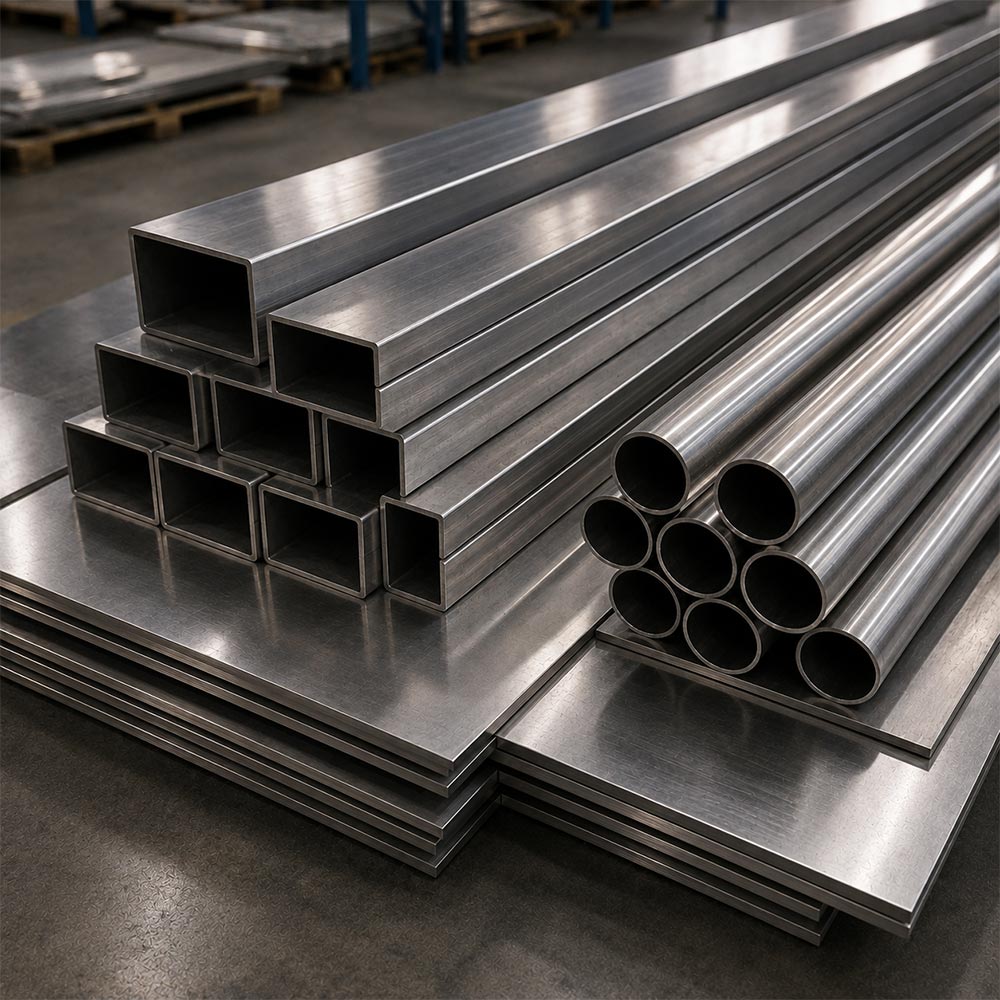
Solitaire Steel & Engineering LLP, based in Khetwadi, Mumbai, India, supplies and exports 317L stainless steel coils, sheets, plates, blocks, ERW pipes, seamless pipes, semi-seamless pipes, tubes, round bars, square bars and wires. Material can be supplied in applicable standards, dimensions and finishes according to the buyer’s process conditions, drawing and quantity.
| Element | Composition (%) |
|---|---|
| Chromium (Cr) | 18.00%–20.00% |
| Nickel (Ni) | 11.00%–15.00% |
| Molybdenum (Mo) | 3.00%–4.00% |
| Carbon (C) | 0.030% maximum |
| Manganese (Mn) | 2.00% maximum |
| Silicon (Si) | 0.75% maximum |
| Phosphorus (P) | 0.045% maximum |
| Sulphur (S) | 0.030% maximum |
| Nitrogen (N) | As limited by the applicable specification |
| Iron (Fe) | Balance |
Chemical limits should be confirmed against the applicable edition of the material specification and supplied material test certificate.
| Property | Metric | Imperial |
|---|---|---|
| Density | Approximately 8.0 g/cm³ | Approximately 0.289 lb/in³ |
| Modulus of Elasticity | Approximately 193 GPa | Approximately 28,000 ksi |
| Poisson’s Ratio | Approximately 0.27–0.30 | Approximately 0.27–0.30 |
| Melting Range | Approximately 1,370°C–1,400°C | Approximately 2,498°F–2,552°F |
| Magnetic Behaviour | Normally non-magnetic when annealed; may become slightly magnetic after cold working | — |
| Property | ASTM A240 Annealed Requirement | Imperial |
|---|---|---|
| Tensile Strength | 515 MPa minimum | 75,000 psi minimum |
| 0.2% Yield Strength | 205 MPa minimum | 30,000 psi minimum |
| Elongation | 40% minimum | 40% minimum |
| Rockwell Hardness | Approximately 95 HRB maximum | Approximately 95 HRB maximum |
| Brinell Hardness | Approximately 217 HBW maximum | Approximately 217 HBW maximum |
Mechanical requirements vary by product specification, form, thickness and manufacturing route. The supplied material test certificate should confirm the applicable values.
| Property | Typical Value |
|---|---|
| Electrical Resistivity | Approximately 0.75–0.80 µΩ·m |
| Electrical Conductivity | Low compared with aluminium and copper |
| Electrical Application Suitability | Selected mainly for corrosion resistance rather than conductivity |
| Property | Typical Value |
|---|---|
| Thermal Conductivity | Approximately 14–16 W/m·K |
| Specific Heat Capacity | Approximately 0.50 J/g·K |
| Mean Thermal Expansion | Approximately 16–17 × 10⁻⁶/°C |
| Melting Range | Approximately 1,370°C–1,400°C |
| Property | Performance |
|---|---|
| Formability | Good |
| Cold Working | Good with significant work hardening |
| Weldability | Excellent with an approved procedure |
| Machinability | Fair; work hardening must be controlled |
| General Corrosion Resistance | Higher than 316L in many selected environments |
| Pitting and Crevice Resistance | Improved by 3%–4% molybdenum |
| Heat-Treatable for Hardening | No |
| Strengthening Method | Cold working |
| Solution Annealing | According to the governing specification |
| Hot Forming | Possible under controlled conditions |
| Pickling and Passivation | Recommended after fabrication where applicable |
Low carbon does not remove the need for proper welding. Heat input, joint preparation, shielding, filler metal, cleaning and passivation should follow an approved welding procedure.
| Designation System | Grade |
|---|---|
| AISI | 317L |
| UNS | S31703 |
| ASTM | Type 317L |
| EN Material Number | 1.4438 |
| EN Designation | X2CrNiMo18-15-4 |
| JIS | SUS 317L |
| ISO Reference | Applicable ISO designation to be confirmed |
| Standard-Carbon Variation | 317 / UNS S31700 |
Equivalent-grade tables are selection guides only. Chemical composition, mechanical properties, product standards and approved service conditions must be compared before substitution.
| Product | Applicable Standards | Available Types | Size Availability | Common Applications |
|---|---|---|---|---|
| Coils | ASTM A240/A240M, ASME SA240 or applicable specification | Hot-rolled, cold-rolled and slit | Standard and customised thicknesses and widths | Fabricated equipment, tanks and welded-tube production |
| Sheets | ASTM A240/A240M, ASME SA240 or applicable specification | HR, CR, plain, perforated and polished | Standard and customised dimensions | Chemical equipment, linings, covers and fabricated parts |
| Plates | ASTM A240/A240M, ASME SA240 or applicable specification | Hot-rolled, annealed, pickled and cut-to-size | Standard and customised dimensions | Welded tanks, reactors, pressure vessels and pulp equipment |
| Blocks | Cut from certified plate or approved stock | Square, rectangular and machined | As per drawing | Valve bodies, pump components, fixtures and machined parts |
| ERW Pipes | ASTM A312/A312M, ASTM A358/A358M or applicable specification | Welded, annealed, pickled or polished | Required OD, wall thickness and length | Chemical transfer, process piping and industrial systems |
| Seamless Pipes | ASTM A312/A312M, ASME SA312 or applicable specification | Seamless, solution-annealed and pickled | Required schedule, OD and length | Chemical, petrochemical and high-integrity piping |
| Semi-Seamless Pipes | As per agreed manufacturing and testing specification | Welded tube subjected to further cold working and finishing | Standard and customised dimensions | Selected industrial and engineering applications |
| Tubes | ASTM A269/A269M, ASTM A249/A249M or applicable specification | Seamless, welded, heat-exchanger and instrumentation tube | Required OD, wall thickness and length | Condensers, heat exchangers and process equipment |
| Round Bars | ASTM A276/A276M, ASTM A479/A479M or applicable specification | Hot-rolled, cold-drawn, forged and bright | Standard and customised diameters and lengths | Valves, pumps, fasteners and machined parts |
| Square Bars | ASTM A276/A276M or applicable specification | Hot-rolled, cold-drawn or machined | Standard and customised sizes | Fabricated and machined components |
| Wires | ASTM A580/A580M or applicable specification | Annealed, drawn, straightened or coil form | Required diameter and coil quantity | Mesh, fasteners, formed parts and specialised fabrication |
The selected standard must expressly cover the required grade and product form. Availability depends on dimensions, finish, testing, quantity and delivery requirements.
| Finish | Appearance and Common Use |
|---|---|
| No.1 | Hot-rolled, annealed and pickled industrial finish |
| 2D | Dull cold-rolled finish |
| 2B | Smooth cold-rolled finish |
| BA | Bright-annealed finish, subject to availability |
| No.4 | Brushed finish for visible equipment |
| Polished Finish | Hygienic and process-equipment applications |
| Pickled and Passivated | Fabricated chemical equipment and piping |
| Electropolished | High-purity and hygienic applications where specified |
| Machined Finish | Bars, blocks, valves and pump components |
| Protective Film | Protection during handling and fabrication |
For pharmaceutical, food-processing or high-purity applications, buyers should specify a measurable surface-roughness requirement rather than asking only for a “polished” finish.
The 3%–4% molybdenum content provides improved resistance to pitting and crevice corrosion compared with 316L in many selected chloride-bearing and chemically aggressive environments. It can also offer better resistance in some sulphurous and other reducing-acid conditions.
Actual performance depends on:
317L should not be described as completely acid-proof, chloride-proof or seawater-proof. Corrosion testing or written material approval may be necessary for critical service.
| Selection Factor | 316L Stainless Steel | 317L Stainless Steel |
|---|---|---|
| UNS Number | S31603 | S31703 |
| Chromium | Approximately 16%–18% | Approximately 18%–20% |
| Nickel | Approximately 10%–14% | Approximately 11%–15% |
| Molybdenum | Approximately 2%–3% | Approximately 3%–4% |
| Maximum Carbon | 0.03% | 0.03% |
| General Corrosion Resistance | Very good | Higher in many selected environments |
| Pitting and Crevice Resistance | Good | Generally better |
| Availability | Widely available | More specialised |
| Initial Cost | Generally lower | Generally higher |
| Typical Use | Marine, pharmaceutical, food and chemical equipment | More demanding chemical, pulp and pollution-control service |
317L should be considered when the process conditions justify improved corrosion resistance beyond 316L. It should not be chosen only because it has a higher grade number.
| Selection Factor | 317 Stainless Steel | 317L Stainless Steel |
|---|---|---|
| UNS Number | S31700 | S31703 |
| Maximum Carbon | 0.08% | 0.03% |
| Molybdenum | 3%–4% | 3%–4% |
| General Corrosion Resistance | High | High |
| Extensive Welding | Requires careful evaluation | Generally preferred |
| Sensitisation Risk | Higher after unsuitable thermal exposure | Reduced |
| Post-Weld Corrosion Performance | Depends strongly on procedure and treatment | Better suited to welded fabrication |
| Typical Use | General corrosion-resistant components | Welded tanks, piping and process equipment |
For heavily welded assemblies where post-weld solution annealing is impractical, 317L is generally the more appropriate grade to evaluate.
317L can be welded using common fusion-welding processes when an approved procedure is followed. Buyers and fabricators should define:
The selected filler metal must provide suitable corrosion resistance for the intended service. Filler selection should be approved by the project welding engineer.
317L may be considered when:
More highly alloyed stainless steel, duplex stainless steel or a nickel alloy may be required for very high chloride levels, concentrated acids or elevated temperatures.
For an accurate technical and commercial quotation, please provide:
For a quotation for 317L stainless steel coils, sheets, plates, blocks, ERW pipes, seamless pipes, semi-seamless pipes, tubes, round bars, square bars or wires, contact Solitaire Steel & Engineering LLP. Our team will review the required standard, dimensions, process conditions, finish, quantity and inspection requirements before confirming availability and pricing.