
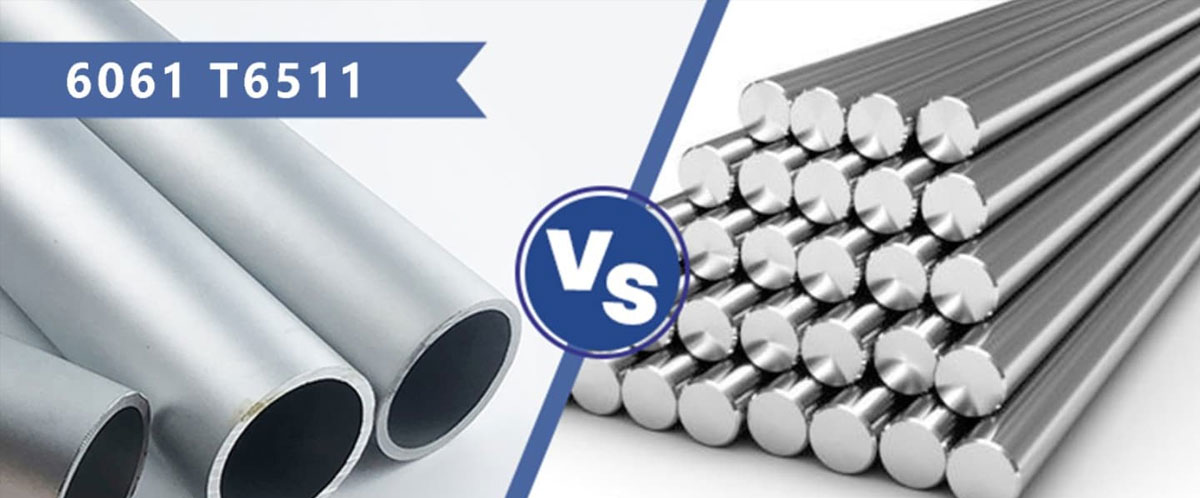
When you’re sourcing aluminium blocks for precision CNC, aerospace tooling, or mould manufacturing, you’ll often see the same alloy (for example 6061 or 7075) offered in two different tempers — T6 and T651.
At first glance they sound identical — both are heat-treated and age-hardened — but the small difference in the temper designation can make a big difference in machining performance, distortion control, and dimensional accuracy.
In this detailed guide, we’ll explain what T6 and T651 actually mean, how they’re made, and which one suits your project based on stress, flatness, and finish requirements.
What Does T6 Mean in Aluminium?
“T6” refers to a specific temper condition achieved after heat-treating.
An aluminium block in the T6 condition is:
- Solution heat-treated – the alloy is heated to dissolve its alloying elements evenly, creating a uniform structure.
- Artificially aged – the block is reheated at a controlled temperature to precipitate strengthening particles, which significantly increase hardness and yield strength.
The result: a strong, heat-treated aluminium block with excellent mechanical properties and a bright, stable surface finish.
Common examples include 6061-T6, 6082-T6, 7075-T6 – all known for their balance of strength and machinability.
What Is T651 – and How It Differs from T6
The T651 temper starts from the same T6 process but adds one critical step:
➡️ Stress-relief stretching.
After heat treatment and ageing, the block is mechanically stretched by 1.5–3 % to relieve residual stresses formed during quenching.
This stretching (also known as stress relief by tension) minimizes internal stress pockets that cause distortion, warping, or movement during high-precision machining.
So, while T6 and T651 share identical chemistry and hardness, the T651 variant provides superior dimensional stability — making it the go-to choice for CNC-machined moulds, jigs, and aerospace components where flatness and consistency are critical.
Key Difference: T6 vs T651 in Simple Terms
| Feature | T6 Temper | T651 Temper |
|---|---|---|
| Heat Treatment | Solution treated + artificially aged | Same as T6 |
| Stress Relief | ❌ No mechanical stress relief | ✅ Stretched 1.5–3 % after aging |
| Dimensional Stability | Moderate | Excellent (flat within ±0.1 mm per meter) |
| Typical Use | General fabrication, welded parts | Precision machining, tooling plates |
| Distortion Resistance | Medium | High |
| Cost | Slightly lower | Slightly higher (~3–5 %) |
| Appearance | Smooth mill finish | Same, may show stretch marks |
| Temper Symbol Breakdown | “T” = heat-treated “6” = aged | “T” = heat-treated “65” = aged + stress-relieved by stretching “1” = minor variations |
Why This Difference Matters to Engineers and Buyers
In high-tolerance CNC jobs, even a 0.2 mm warp can ruin an entire mould or fixture.
That’s why most professional manufacturers prefer T651 aluminium blocks — they stay flat after machining, maintain consistent tolerances, and reduce rework time.
Meanwhile, T6 aluminium remains ideal for fabricated or welded assemblies where cost and weldability matter more than tight tolerances.
💬 Common Buyer Questions
- “Is T651 stronger than T6?”
➤ No — strength is similar, but T651 resists warping better. - “Is T651 worth the extra cost?”
➤ Yes, for any machined part or precision tooling, the dimensional control pays back in fewer rejects. - “Can I use T6 instead of T651?”
➤ Yes — for general fabrication or welding jobs where stress relief isn’t essential.
⚙️ Technical Comparison: Aluminium T6 vs T651 Temper
While both T6 and T651 aluminium blocks share the same heat-treatment origin, their post-processing defines how they perform in machining and stress environments.
Below is a comprehensive technical comparison designed for engineers, buyers, and manufacturers who need clarity before procurement.
T6 vs T651 Aluminium Temper Comparison Table
| Parameter | T6 Aluminium Blocks | T651 Aluminium Blocks |
|---|---|---|
| Heat Treatment Process | Solution heat-treated and artificially aged | Same as T6, then mechanically stretched 1.5–3% |
| Stress Relief Method | None | Stress relieved by stretching after ageing |
| Internal Stress Residue | Higher (may distort under heavy machining) | Significantly reduced (stable under load) |
| Flatness & Dimensional Accuracy | Standard tolerance | Excellent flatness (±0.1 mm/m typical) |
| Machinability | Very good | Excellent (less tool chatter and warping) |
| Tensile Strength (MPa) | 290–310 (6061) | 290–310 (same alloy basis) |
| Yield Strength (MPa) | 240–275 | 240–275 |
| Elongation (%) | 10–17 | 10–17 |
| Brinell Hardness (HB) | 95–105 | 95–105 |
| Corrosion Resistance | Excellent | Excellent |
| Weldability | Excellent | Excellent |
| Typical Applications | General fabrication, structural, welded frames | Machined tooling, dies, jigs, precision plates |
| Cost Differential | Economical | +3–5% higher (offset by accuracy) |
| Common Alloys Available | 6061-T6, 6082-T6, 7075-T6 | 6061-T651, 6082-T651, 7075-T651 |
Process Insight: What Makes T651 Superior for Machining
When aluminium billets are quenched after heat treatment, rapid cooling traps residual stresses inside the metal structure.
These stresses remain “locked in” — and when the block is milled or cut, it can release unevenly, leading to distortion, bowing, or twisting.
👉 The T651 temper solves this problem through controlled stretching or compression that redistributes these internal stresses evenly.
The result: a plate or block that stays flat, stable, and dimensionally predictable throughout machining, making it the preferred choice for CNC shops and mould manufacturers.
🛠️ Use-Case Comparison: Where Each Temper Works Best
| Industry / Application | Preferred Temper | Reason |
|---|---|---|
| CNC Machining of Jigs & Fixtures | T651 | Dimensional stability under multiple tool passes |
| Mould & Tool Base Manufacturing | T651 | Maintains flatness and prevents warping |
| Aerospace Components | T651 | Certified precision & fatigue reliability |
| Automotive & EV Frames | T6 | Excellent weldability and cost balance |
| Marine Fabrication | T6 | High corrosion resistance, easy forming |
| Architectural Profiles | T6 | Ideal for anodizing and extrusion |
| Precision Machined Parts | T651 | Better consistency under stress relief conditions |
| Prototyping or Structural Fabrication | T6 | Sufficient accuracy for medium tolerances |
Quick Tip:
If your job involves heavy milling, drilling, or facing on large plates, always choose T651.
If your project involves welding or bending, T6 will save cost and still perform perfectly.
Case Study – From T6 to T651: A Real-World Improvement
A Pune-based mould manufacturer was facing flatness variation and warpage issues while machining 6061-T6 blocks for die bases.
After switching to 6061-T651 plates from Solitaire Steel & Engineering LLP, results improved dramatically:
- Distortion dropped by 70% during roughing operations
- Machining time reduced by 20% due to reduced tool chatter
- Surface finishing improved with less rework and polishing
- Plate rejection rate fell from 5% to <1%
The slightly higher cost of T651 was recovered in just two production cycles through reduced machining and correction time.
Performance Summary: T6 vs T651
| Factor | Preferred Temper | Reason |
|---|---|---|
| Dimensional Flatness | T651 | Stress-relieved and stable |
| Machining Accuracy | T651 | Less distortion, ideal for CNC |
| Cost Efficiency | T6 | Lower cost for fabrication |
| Welded Assemblies | T6 | Excellent weld response |
| Anodizing Quality | T6 | Smooth finish, aesthetic appeal |
| Repeatability for High Precision Jobs | T651 | Consistent across multiple machining cycles |
Comparisons
Q: What is the main difference between T6 and T651 aluminium?
T651 is the same as T6 but has been stretched (1.5–3%) to relieve internal stress, preventing distortion during machining.
Q: Is T651 stronger than T6?
No — both have identical mechanical strength; T651 simply maintains its shape better.
Q: Which is better for CNC machining — T6 or T651?
T651 is always preferred for CNC, tooling, and mould bases due to its superior dimensional stability.
Q: Can T6 be converted to T651?
Yes — by performing controlled stretching after the T6 process, the block can be reclassified as T651.
Global Supply & Export Capabilities
At Solitaire Steel & Engineering LLP, we are India’s trusted source for Aluminium T6 and T651 Blocks & Plates, delivering precision-engineered products to 45+ countries across 5 continents.
Our inventory covers the complete range of alloys — 6061, 6082, 7075, 2014, and 5083 — available in both T6 and T651 tempers.
Each block is:
- Ultrasonically tested (UT 100%)
- EN 10204 3.1 certified
- Dimensionally inspected for flatness and thickness tolerance
- Supplied cut-to-size for CNC and moulding applications
🌐 Regular Export Destinations:
UAE | Saudi Arabia | Germany | Vietnam | USA | Canada | Australia | South Africa | Netherlands | Qatar | Malaysia
📦 Export packaging includes: moisture-barrier wrapping, edge protectors, ISPM-15 heat-treated pallets, barcoding, and mill traceability — ensuring safe delivery from Mumbai to any global port.
How to Choose Between T6 and T651 Aluminium Blocks
| Requirement / Scenario | Recommended Temper | Reason |
|---|---|---|
| General fabrication or welded structures | T6 | Lower cost, great weldability |
| CNC machining, tooling, mould bases | T651 | Stress-relieved for dimensional stability |
| Precision aerospace or defence parts | T651 | Eliminates warping, consistent tolerances |
| Marine & architectural fabrication | T6 | Excellent corrosion resistance and finish |
| High-speed machining (multi-axis CNC) | T651 | Reduces vibration and tool chatter |
| Prototyping / experimental builds | T6 | Easier to cut and shape |
| Tight-tolerance jigs and dies | T651 | Maintains flatness across multiple operations |
If your process involves heavy roughing and finishing passes, always invest in T651 — its stability eliminates post-machining corrections.
For fabricated or welded frames, T6 remains a smarter, cost-efficient choice.
FAQs
Q1. What is the difference between T6 and T651 aluminium?
T651 is produced from T6 aluminium but stretched 1.5–3 % to relieve internal stresses, preventing distortion during machining.
Q2. Does T651 aluminium have higher strength than T6?
No — both tempers share the same mechanical strength. The only difference is T651’s stress-relieved stability.
Q3. Which temper is best for CNC machining?
T651. It holds tight tolerances, stays flat, and minimizes rework after milling.
Q4. Can I weld T651 aluminium?
Yes, but T6 is usually preferred for welded assemblies as T651 is optimized for machining, not bending or welding.
Q5. What are the most common alloys available in T6 and T651 tempers?
6061, 6082, and 7075 aluminium are widely available in both T6 and T651 forms.
Q6. Is there a big price difference between T6 and T651?
T651 costs only 3–5 % more, but the reduced machining time and scrap savings often offset this premium.
Q7. Can T6 be converted to T651 later?
Yes. After heat treatment and ageing, controlled stretching can convert a T6 block to T651 condition.
Q8. Who supplies certified T6 and T651 aluminium blocks in India?
Solitaire Steel & Engineering LLP — leading manufacturer and exporter of ASTM B209 / EN 485-2 certified aluminium blocks.
Speak to Our Alloy Experts
Confused between T6 and T651 aluminium?
Get a free technical consultation from our material engineers to help you choose the correct temper for your machining or fabrication project.
📩 Email: info@solitairesteelllp.com
📱 Call / WhatsApp: +91 9819046580
🌐 Request a Quote: [Talk to Our Expert]
🧾 We provide alloy selection assistance, grade certificates, and precision-cut plates ready for immediate export.
Precision Starts with the Right Temper
Both T6 and T651 aluminium blocks deliver strength, durability, and performance — but only one stays perfectly flat under the spindle.
Choose T6 for cost-effective fabrication.
Choose T651 for precision machining, aerospace tooling, and mould applications where every micron matters.
At Solitaire Steel & Engineering LLP, we combine:
- Certified alloys
- Tight dimensional control
- Fast global delivery
to ensure you get not just aluminium — but engineering-grade performance you can trust.
From the shop floor to the sky — T651 delivers where precision is everything.