

What Does T6 Mean in Aluminium?
T6 means that a suitable aluminium alloy has undergone three sequential treatment stages:
Solution Heat Treatment
The alloy is heated within a controlled temperature range so that soluble alloying constituents enter a solid solution.
Rapid Cooling — Quenching
The material is cooled rapidly to retain dissolved elements in a supersaturated condition. The quenching method and control depend on the alloy, section thickness and production process.
Artificial Ageing
The quenched material is held at an elevated temperature for a controlled period. Fine precipitates form throughout the material and increase its strength and hardness.
This treatment creates fine precipitates within the alloy's structure, which restrict movement inside the metal and increase its strength and hardness. In standard temper terminology, T6 applies to products that are solution heat-treated and then artificially aged. Any cold working performed only for flattening or straightening is not considered to affect the specified mechanical-property limits.
Quick Buyer Answer
| Buyer Question | Practical Answer |
|---|---|
| Is T6 an aluminium grade? | No. The alloy comes first — 6061, 6082 or 7075; T6 identifies its heat-treated condition. |
| What does T6 provide? | Generally higher strength and hardness than annealed or naturally aged conditions of the same alloy. |
| Is every aluminium alloy available in T6? | No. T6 applies only to suitable heat-treatable alloys. |
| Is T6 always the best temper? | No. It may not be preferable when extensive bending, forming, welding or stress-corrosion resistance is the main requirement. |
| What should a buyer specify? | Alloy, temper, product form, size, quantity, standard, application and required documentation. |
Key Characteristics of T6 Aluminium
T6 treatment can change the mechanical behaviour of an aluminium alloy significantly. The precise result must always be checked against the relevant alloy and product standard.
| Characteristic | Typical T6 Behaviour | Why It Matters to the Buyer |
|---|---|---|
| Strength | Higher than softer tempers of the same alloy | Supports structural and load-bearing components |
| Hardness | Increased through precipitation hardening | Useful for wear-prone or machined components |
| Machinability | Often suitable for controlled CNC machining | Helps produce accurate engineering parts |
| Formability | Lower than softer conditions such as O or T4 | Tight bending or deep forming may be more difficult |
| Dimensional Stability | Generally better than softer conditions, but residual stress can remain | Important when machining plates or blocks |
| Corrosion Resistance | Depends mainly on the alloy and exposure condition | Temper alone does not determine corrosion performance |
| Weldability | Alloy-dependent; welding can soften the heat-affected zone | Joint design must consider reduced local strength |
| Surface Treatment | Many T6 alloys can be anodised or coated | Suitability and appearance depend on the alloy and finish |
Aluminium Alloys Commonly Requested in T6 Temper
Availability varies by product form, thickness, manufacturing route and applicable standard.
Balanced strength, corrosion resistance, machining and general fabrication capability.
Commonly associated with extruded and architectural products where higher strength than T5 is required.
Higher-strength 6000-series option commonly considered for structural engineering.
High-strength aluminium-copper alloy with good machining characteristics.
High-strength aluminium-zinc alloy for the most demanding structural and machined needs.
Alloys That Should Not Automatically Be Specified as T6
Commercially pure and non-heat-treatable wrought alloys are generally strengthened by strain hardening rather than T6 heat treatment. These materials normally use O or H-series temper designations. Buyers should not add "T6" to every aluminium enquiry without confirming that the selected alloy supports that temper.
- Aluminium 1050
- Aluminium 1100
- Many 3000-series alloys
- Many 5000-series alloys, including commonly supplied 5083 conditions
T6 Aluminium Product Forms
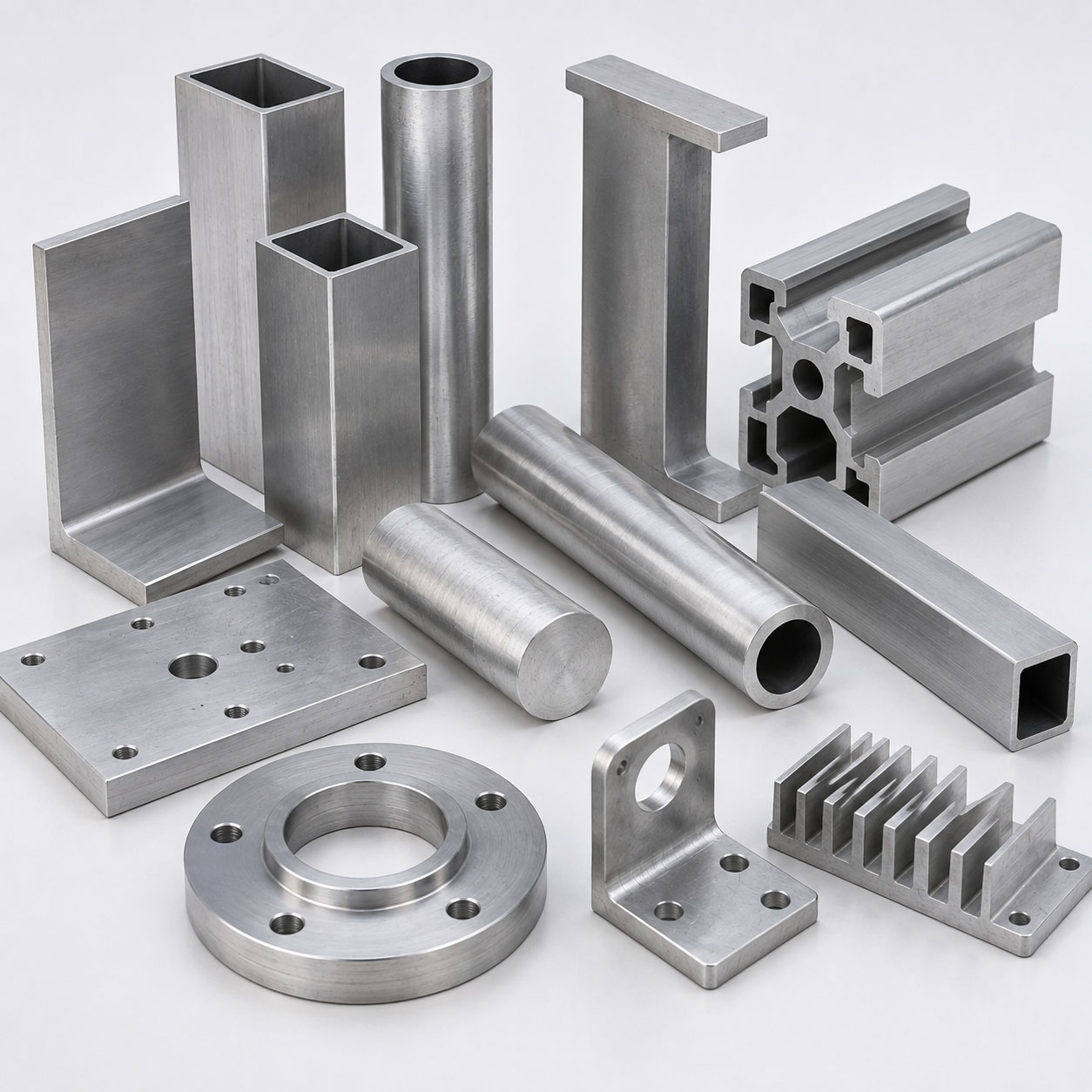
Solitaire Steel & Engineering LLP can assist buyers with suitable alloy and temper enquiries across different product forms, subject to actual availability.
| Product Form | Typical Buyer Requirements |
|---|---|
| Aluminium T6 Plates | Alloy, thickness, width, length, flatness, surface condition and machining allowance |
| Aluminium T6 Sheets | Alloy, thickness, sheet size, finish, tolerance and forming requirement |
| Aluminium T6 Blocks | Alloy, block dimensions, machining allowance, flatness and ultrasonic-testing requirement, if applicable |
| Aluminium T6 Round Bars | Alloy, diameter, length, tolerance, finish and machining requirement |
| Aluminium T6 Flat Bars | Width, thickness, length, edge condition and straightness |
| Aluminium T6 Pipes | Outside diameter, wall thickness, length, pipe specification and end condition |
| Aluminium T6 Tubes | OD, ID or wall thickness, shape, tolerance and application |
| Aluminium T6 Extrusions | Alloy, profile drawing, section dimensions, temper, tolerance and surface finish |
| Aluminium T6 Angles & Channels | Section size, thickness, length, alloy and structural requirement |
Where Is T6 Aluminium Used?
The final alloy should be selected according to load, environment, joining method, machining requirement and governing design code.
CNC Machining & Precision
- CNC-machined components
- Jigs and fixtures
- Machine frames & mounting plates
- Equipment housings
- Automation & robotics parts
- Instrument bodies
Structural Engineering
- Structural frames & trusses
- Platforms and walkways
- Support members
- Industrial assemblies
- Transport structures
Automotive & Transport
- Lightweight frames
- Brackets & mounting parts
- Suspension-related components
- Machined vehicle parts
Architectural Extrusions
- Frames, railings, façade profiles
- Doors and windows
- Architectural sections
- Display & partition systems
Marine & Outdoor
- Marine fittings and frames
- Above-water structures
- Outdoor structural components
High-Strength Machined Parts
- 2014-T6 and 7075-T6 components
- Heavy-duty tooling
- Performance fixtures
- Highly loaded machined parts
T4 vs T5 vs T6 Aluminium
| Temper | Treatment Route | General Behaviour | Buyer Consideration |
|---|---|---|---|
| T4 | Solution heat-treated and naturally aged | Lower strength and greater formability than T6 for many alloys | May suit parts that require forming before final ageing |
| T5 | Cooled after elevated-temperature shaping and artificially aged | Common with extrusions; properties depend on alloy and process | Often selected for extruded profiles |
| T6 | Solution heat-treated and artificially aged | Generally higher strength than T4 and often T5 for the same alloy and product form | Suitable when specified strength is more important than extensive forming |
T5 and T6 are not interchangeable merely because they use the same base alloy. The correct temper must be confirmed from the design specification and required mechanical properties.
T6 vs T651 Aluminium
T651 begins with the T6 treatment route and includes controlled stress relief by stretching.
| Selection Point | T6 | T651 |
|---|---|---|
| Solution heat-treated | Yes | Yes |
| Artificially aged | Yes | Yes |
| Stress-relieved by stretching | Not part of the basic T6 designation | Yes |
| Residual-stress control | Standard T6 condition | Generally improved |
| Heavy CNC machining | Can be suitable | Often preferred for thick plates and blocks |
| Distortion risk during material removal | May be higher in some sections | Generally lower, although not eliminated |
| Typical procurement concern | Strength and general engineering use | Dimensional stability during machining |
Choose T651 when substantial machining will remove material unevenly or when dimensional stability is critical. Do not assume that T651 is necessary for every component.
T6 vs O Temper Aluminium
| Selection Factor | O Temper | T6 Temper |
|---|---|---|
| Condition | Annealed | Solution heat-treated and artificially aged |
| Strength | Lower | Higher for a suitable heat-treatable alloy |
| Hardness | Lower | Higher |
| Ductility & Formability | Generally higher | Generally lower |
| Tight bending & deep forming | More suitable in many cases | Greater risk of cracking or springback |
| Machined or load-bearing parts | May be too soft | Often more suitable |
| Suitable alloy families | Heat-treatable and non-heat-treatable alloys may be available in O | Only suitable heat-treatable alloys |
A component that requires extensive forming may be formed in a softer temper and subsequently heat-treated where the alloy, part design and qualified production process permit.
Advantages of Aluminium T6 Temper
✔ Key Advantages
- Higher strength than softer conditions of the same alloy
- Useful strength-to-weight performance
- Good machining potential in several commercial alloys
- Suitable for many structural and engineering applications
- Available across multiple heat-treatable aluminium grades
- Compatible with several finishing processes, depending on alloy
- Established temper designation understood by industrial buyers worldwide
✗ General Limitations
- Reduced formability — tight bending can cause cracking
- Welding reduces local strength in the heat-affected zone
- Residual stress can cause machining distortion
- Corrosion resistance is alloy-dependent, not temper-dependent
- Elevated-temperature exposure can reduce mechanical performance
- "T6 plate required" alone is an incomplete specification
These are general advantages. Actual performance depends on alloy, product form, dimensions, standard and service conditions.
Limitations Buyers Must Consider
Reduced Formability
T6 material is harder and less ductile than annealed or naturally aged material. Tight-radius bending, deep drawing or severe forming can cause cracking.
Welding Can Reduce Local Strength
The heat from welding changes the material condition around the joint. The heat-affected zone may not retain the original T6 mechanical properties. Welded structures should be designed using applicable post-weld properties and engineering codes — not the unwelded parent-material strength alone.
Residual Stress and Machining Distortion
Standard T6 plates and blocks can contain residual stress from heat treatment and quenching. Removing a large amount of material from one side may release this stress and cause movement. For precision components involving extensive machining, compare T6 with T651 or another stress-relieved condition.
Corrosion Resistance Is Alloy-Dependent
T6 does not describe corrosion resistance. For example, 6061-T6 and 7075-T6 have different corrosion characteristics even though both carry the same temper suffix.
Elevated-Temperature Exposure
Prolonged exposure to elevated temperatures can change the precipitation-hardened condition and reduce mechanical performance. Confirm the operating-temperature requirement before selection.
T6 Is Not a Substitute for a Complete Specification
"Aluminium T6 plate required" is incomplete. The alloy, standard, thickness, dimensions, properties and documentation must also be specified.
How to Select the Right T6 Aluminium
Before requesting a quotation, answer these questions:
Practical Selection Guide
| Requirement | Temper / Alloy Direction to Evaluate |
|---|---|
| General-purpose machined or structural component | 6061-T6 |
| Higher-strength structural engineering | 6082-T6 |
| Architectural extrusion requiring higher strength | 6063-T6 |
| High-strength machined component | 2014-T6 or 7075-T6 |
| Extensive precision machining of thick stock | Compare T6 with T651 |
| Extensive bending or forming | Consider T4 or O — subject to alloy and final treatment |
| Direct seawater exposure | Evaluate marine-grade alloy and approved temper; do not select on T6 alone |
| Welded load-bearing assembly | Confirm alloy weldability and post-weld design strength |
This table is preliminary guidance, not an engineering approval.
Standards and Documentation to Confirm
The relevant standard depends on whether the requirement is for plate, sheet, extrusion, bar, tube, pipe or another form. Buyers may specify:
- Alloy and temper designation
- Product-form standard
- Chemical-composition requirements
- Mechanical-property requirements
- Dimensional tolerances
- Surface condition
- Flatness or straightness
- Heat or batch traceability
- Material test certificate
- Third-party inspection, when contractually required
- Additional testing stated in the purchase specification
Information Required for an Accurate T6 Aluminium Quotation
| Required Information | Example |
|---|---|
| Aluminium alloy | 6061, 6063, 6082, 2014 or 7075 |
| Temper | T6, T651 or another specified condition |
| Product form | Plate, sheet, block, bar, pipe, tube or extrusion |
| Dimensions | Thickness × width × length or OD × wall thickness × length |
| Quantity | Pieces, kilograms, tonnes or total length |
| Standard | ASTM, EN or customer specification |
| Dimensional tolerance | Standard or special tolerance |
| Surface condition | Mill finish, machined, anodising requirement or protective covering |
| Processing | Cut size or full-size material |
| Application | Structural, machining, architectural, marine or general engineering |
| Documentation | MTC, traceability or inspection requirement |
| Delivery | City, country, port and required date |
Source T6 Aluminium Products from Solitaire Steel & Engineering LLP
How Solitaire Steel & Engineering LLP Can Help
Solitaire Steel & Engineering LLP, Mumbai, India, supports domestic and export enquiries for aluminium products across multiple grades, tempers and product forms. The team can help buyers check:
- Appropriate alloy and temper options
- Product-form availability
- Standard and dimensional requirements
- Cut-size requirements
- Documentation requested in the purchase order
- Packing and delivery information
- Domestic and export quotation requirements