

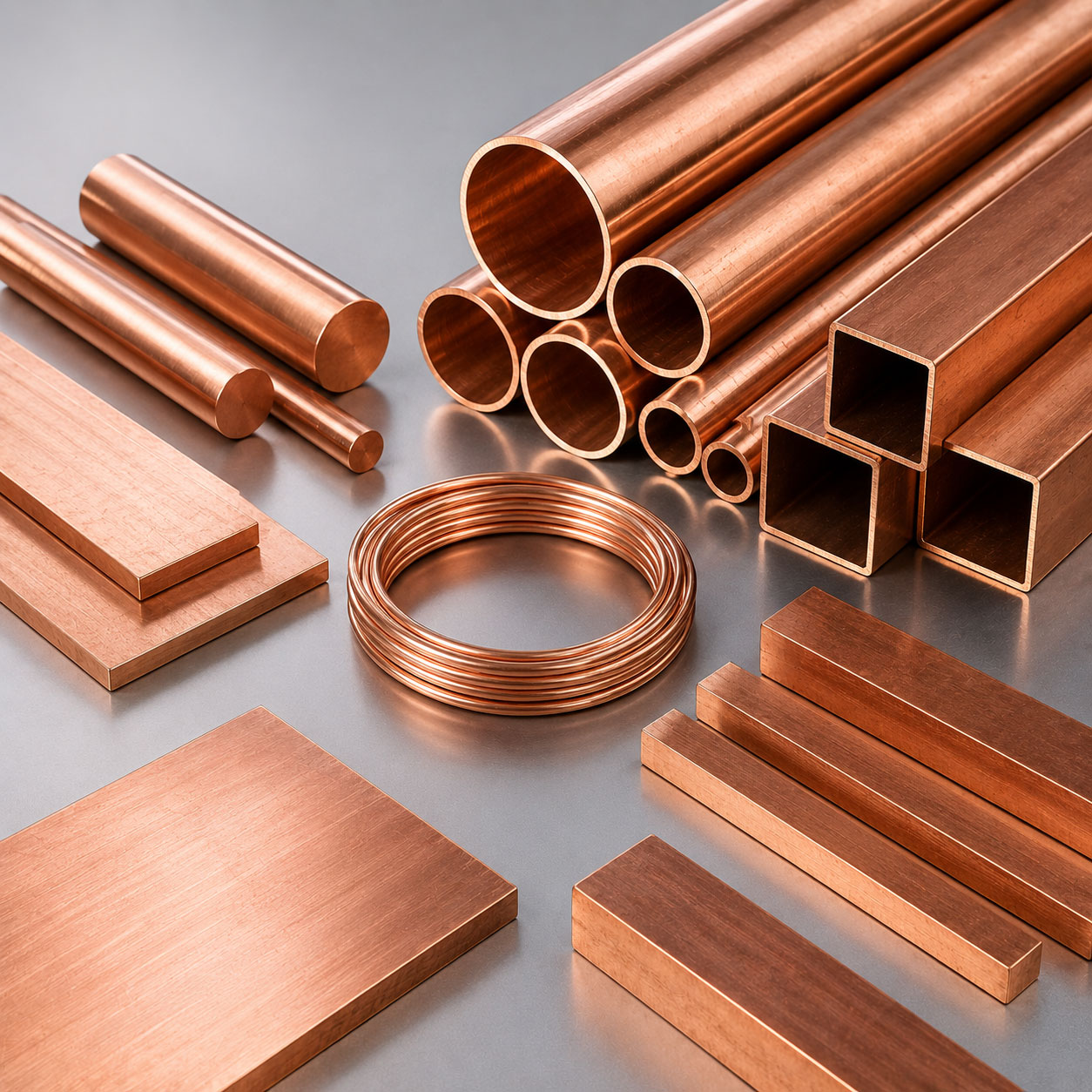
What Is Copper?
Copper is a naturally occurring metallic element identified by the symbol Cu. It is recognised by its reddish-brown colour and its ability to conduct electricity and heat efficiently.
Commercial copper products include:
- High-conductivity copper
- Electrolytic tough pitch copper
- Oxygen-free copper
- Deoxidised copper
- Free-machining copper
- Brass
- Bronze
- Copper-nickel alloys
- Other specialised copper alloys
The selected material must match the intended electrical, thermal, forming, machining, brazing or corrosion requirement.
Quick Buyer Answer
| Buyer question | Practical answer |
|---|---|
| Why is copper used for electrical components? | It combines very high electrical conductivity with useful ductility, joining capability and reliability. |
| Is every copper grade equally conductive? | No. Alloying elements, oxygen, phosphorus, impurities and processing affect conductivity. |
| Which copper is commonly used for busbars? | High-conductivity grades such as ETP copper are commonly evaluated, but the exact grade and conductivity requirement must be specified. |
| Which copper is used for plumbing and heat exchangers? | Deoxidised copper is commonly considered for tubes and brazed systems, subject to the applicable product standard. |
| Is copper naturally corrosion-proof? | No. It resists many environments but can corrode under unsuitable chemical, water-quality, velocity or galvanic conditions. |
| What should a buyer specify? | Grade, temper, product form, dimensions, quantity, standard, application, conductivity and documentation requirements. |
Main Properties of Copper
The exact values must be verified against the selected grade, temper, thickness and product standard.
| Property | General copper behaviour | Why it matters to the buyer |
|---|---|---|
| Electrical conductivity | Very high in suitable unalloyed grades | Important for cables, busbars, terminals and electrical contacts |
| Thermal conductivity | Very high | Supports heat exchangers, cooling plates and refrigeration systems |
| Ductility | Generally high in soft tempers | Enables wire drawing, tube forming and deep drawing |
| Malleability | Can be rolled, pressed and shaped | Useful for sheets, strips, roofing and formed components |
| Corrosion resistance | Good in many atmospheric and water environments | Supports long service when grade and conditions are suitable |
| Joining capability | Can be soldered, brazed or welded using suitable procedures | Important for plumbing, refrigeration and fabricated assemblies |
| Strength | Lower in pure annealed copper; increases through cold working or alloying | Temper and alloy must match the mechanical load |
| Machinability | Pure copper can be difficult to machine; specialised grades perform better | Affects tooling, finish and production rate |
| Fatigue resistance | Grade-, temper- and design-dependent | Important for vibrating or repeatedly flexed parts |
| Non-magnetic behaviour | Copper is generally non-ferromagnetic | Useful around sensitive electrical and magnetic equipment |
| Surface appearance | Reddish metallic surface develops oxides or patina with exposure | Important for architectural and decorative use |
| Density | Higher than aluminium | Affects component weight and material calculation |
| Recyclability | Copper can be recovered and reused | Supports material recovery and lifecycle planning |
- Copper purity
- Alloying elements
- Oxygen content
- Phosphorus content
- Residual impurities
- Temper and cold working
- Temperature
- Manufacturing route
- Applicable conductivity-testing method
IACS Conductivity
Electrical conductivity is often expressed as a percentage of the International Annealed Copper Standard, abbreviated as % IACS.
A conductivity requirement should state:
- Minimum % IACS
- Test method
- Test temperature, where relevant
- Grade
- Temper
- Product form
The material certificate or inspection document should be checked rather than accepting a general “pure copper” description.
Main Copper Grade Families
Electrolytic Tough Pitch Copper
Electrolytic tough pitch, or ETP, copper is widely used for electrical applications because it provides high conductivity and practical manufacturing performance.
A common UNS designation is C11000.
Commonly evaluated for:
- Busbars
- Electrical conductors
- Terminals
- Switchgear components
- Transformer parts
- Earthing components
- Electrical strips
- Motor components
Selection caution: ETP copper contains controlled oxygen and may not suit processing in certain reducing atmospheres or particular high-temperature joining operations.
Oxygen-Free Copper
Oxygen-free copper grades are produced with very low oxygen content.
Common designations include:
- C10100
- C10200
Commonly evaluated for:
- High-integrity electrical components
- Vacuum equipment
- Electronic applications
- Special heat-transfer components
- Components exposed to reducing atmospheres
- High-purity fabrication requirements
Buyer consideration: Do not specify oxygen-free copper unless oxygen content, conductivity, purity or processing conditions make it necessary.
Phosphorus-Deoxidised Copper
Phosphorus-deoxidised copper is commonly used for tubes, pipes and fabricated components requiring good forming and joining performance.
A common designation is C12200.
Commonly evaluated for:
- Plumbing tubes
- Refrigeration tubing
- Air-conditioning systems
- Heat exchangers
- Solar thermal systems
- Brazed tube assemblies
- General fabricated copper components
Selection caution: Residual phosphorus can reduce electrical conductivity compared with high-conductivity ETP or oxygen-free electrical copper.
Free-Machining Copper
Grades such as tellurium copper are developed to improve machinability while retaining useful electrical or thermal performance.
A common designation is C14500.
Commonly evaluated for:
- Machined electrical connectors
- Threaded components
- Terminals
- Fasteners
- Precision electrical parts
- CNC-turned components
The exact alloy content, conductivity and application requirements must be verified.
Copper Alloys
Copper can be alloyed to obtain greater strength, wear resistance, machinability or corrosion performance.
| Copper-alloy family | Main alloying direction | Common buyer requirement |
|---|---|---|
| Brass | Copper and zinc | Formability, machinability, fittings and decorative use |
| Phosphor bronze | Copper and tin with phosphorus | Springs, bearings and wear components |
| Aluminium bronze | Copper and aluminium | Strength and marine-related corrosion resistance |
| Silicon bronze | Copper and silicon | Fabrication, fasteners and architectural components |
| Copper-nickel | Copper and nickel | Seawater piping and marine heat-transfer systems |
| Beryllium copper | Copper and beryllium | High strength, springs and specialised electrical contacts |
| Nickel silver | Copper, nickel and zinc | Decorative components and formed products |
Copper alloys should not be specified simply as “copper.” Their compositions and properties differ substantially from unalloyed copper.
Common Copper Grades and Buyer Selection
| Grade | General description | Typical selection reason | Important limitation |
|---|---|---|---|
| C10100 | Oxygen-free electronic copper | High purity and demanding electrical/electronic use | Cost and availability may differ from common ETP copper |
| C10200 | Oxygen-free copper | Electrical, thermal and reducing-atmosphere service | Must verify exact conductivity and oxygen limits |
| C11000 | ETP copper | Busbars, conductors and general electrical parts | Requires care in certain reducing-atmosphere processing |
| C12000 | Phosphorus-deoxidised, low residual phosphorus | Formed and joined products requiring more conductivity than higher-phosphorus grades | Product availability depends on form |
| C12200 | Phosphorus-deoxidised, high residual phosphorus | Tube, plumbing, refrigeration and brazed assemblies | Lower conductivity than high-conductivity electrical copper |
| C14500 | Tellurium copper | Improved machinability with useful conductivity | Not selected where maximum purity or conductivity is mandatory |
These descriptions are preliminary. The purchase order must state the applicable ASTM, EN, BS, IS, JIS or customer specification.
Copper Temper Designations
Temper describes the mechanical condition created by annealing, cold working or another controlled process. It affects strength, hardness, ductility and forming capability.
| General temper condition | Typical behaviour | Buyer consideration |
|---|---|---|
| Annealed/soft | Highest ductility and lowest strength for the grade | Suitable for severe forming, bending and tube manipulation |
| Quarter-hard | Moderate strength with useful formability | Considered for light forming and general components |
| Half-hard | Higher strength and reduced ductility | Common for strips, sheets and formed electrical parts |
| Hard | Greater strength and springback | Suitable where rigidity is more important than severe forming |
| Spring temper | High elastic response in suitable alloys | Used for clips, contacts and spring components |
| Drawn condition | Properties depend on reduction and product standard | Common in wire, tube and bar products |
Exact temper codes vary between standards and product forms. Buyers should state the complete designation shown on the drawing or material specification.
Annealed vs Hard Copper
| Selection factor | Annealed copper | Hard-drawn or hard copper |
|---|---|---|
| Strength | Lower | Higher |
| Hardness | Lower | Higher |
| Ductility | Higher | Lower |
| Bending | Generally easier | Requires more control |
| Electrical conductivity | Grade- and condition-dependent | Can differ slightly due to cold working |
| Dimensional rigidity | Lower | Higher |
| Springback | Lower | Higher |
| Typical use | Tubing, forming, flexible connections and drawn parts | Busbars, conductors and rigid fabricated parts |
Temper must be selected according to the fabrication route and final component requirement.
Copper Product Forms
Solitaire Steel & Engineering LLP can review copper requirements in various forms, subject to grade, temper, dimensions and availability.
| Product form | Information buyers should specify |
|---|---|
| Copper sheets | Grade, temper, thickness, width, length, finish and tolerance |
| Copper plates | Grade, temper, thickness, dimensions, flatness and application |
| Copper coils | Grade, temper, thickness, width, coil ID/OD and coil weight |
| Copper strips | Grade, temper, thickness, width, edge and coil condition |
| Copper circles | Grade, temper, diameter, thickness and spinning or drawing requirement |
| Copper busbars | Grade, width, thickness, length, edge radius, straightness and conductivity |
| Copper flat bars | Width, thickness, length, temper and dimensional tolerance |
| Copper round bars | Grade, diameter, length, temper and machining requirement |
| Copper square bars | Grade, section size, length, tolerance and application |
| Copper rods | Grade, diameter, coil or straight length and end application |
| Copper pipes | Grade, OD or nominal size, wall, length, standard and service |
| Copper tubes | Grade, temper, OD, wall thickness, length, tolerance and application |
| Copper capillary tubes | OD, ID, length, cleanliness and refrigeration requirement |
| Copper wire | Grade, diameter, temper, conductivity and coil requirement |
| Copper foil | Grade, thickness, width, temper and surface condition |
| Copper profiles | Grade, drawing, dimensions, tolerance and conductivity requirement |
Copper Sheets, Plates and Strips
Copper flat products are commonly selected for:
- Electrical components
- Heat-transfer plates
- Roofing
- Cladding
- Decorative work
- Gaskets
- Terminals
- Transformer components
- Formed industrial parts
Buyers should confirm:
- Grade and temper
- Conductivity
- Surface condition
- Flatness
- Edge quality
- Grain direction
- Thickness tolerance
- Protective covering
- Forming requirement
Copper Busbars
Copper busbars are used to distribute electrical power in switchboards, panel boards, transformers and industrial electrical systems.
Important buying parameters include:
- Copper grade
- Minimum conductivity
- Cross-sectional dimensions
- Length
- Straightness
- Edge radius
- Surface condition
- Hole pattern, when purchasing processed parts
- Plating requirement
- Current and temperature-rise design
- Material certificate
Copper Pipes and Tubes
Copper tubing is used in:
- Plumbing
- Refrigeration
- Air conditioning
- Heat exchangers
- Medical-gas systems
- Solar thermal equipment
- Industrial fluid transfer
- Instrumentation
A complete tube enquiry should state:
- Copper grade
- Annealed or hard condition
- Outside diameter
- Wall thickness
- Straight length or coil
- Seamless construction, if required
- Applicable product standard
- Cleanliness requirement
- Pressure and temperature
- Fluid or refrigerant
- End condition
- Inspection requirement
“Copper tube required” is not sufficient for medical-gas, refrigeration or pressure service.
Major Applications of Copper
Electrical Power Distribution
Copper is widely used for:
- Busbars
- Cables
- Conductors
- Earthing systems
- Switchgear
- Transformer windings
- Motor windings
- Generator components
- Electrical terminals
- Distribution boards
The selected grade must meet conductivity, dimensional, joining and temperature requirements.
Electronics and Telecommunications
Applications include:
- Printed circuit boards
- Connectors
- Terminals
- Lead frames
- Electronic shielding
- Telecommunications cables
- Power electronics
- Semiconductor equipment
- Data and signal systems
Surface finish, plating adhesion, flatness and purity may be critical.
Heat Exchangers and Cooling Systems
Copper and suitable copper alloys are considered for:
- Heat-exchanger tubes
- Condensers
- Evaporators
- Cooling coils
- Radiators
- Heat sinks
- Cold plates
- Refrigeration systems
- HVAC equipment
Fluid chemistry, pressure, temperature, velocity and galvanic compatibility must be evaluated.
Plumbing and Water Systems
Copper tubes may be used for:
- Hot- and cold-water lines
- Heating systems
- Drainage components
- Fire-protection systems
- Building services
- Solar water heating
Water composition, flow velocity, installation method and joining procedure influence long-term performance.
Refrigeration and Air Conditioning
Copper is commonly considered for:
- Refrigerant lines
- Condenser coils
- Evaporator coils
- Capillary tubes
- Heat-pump systems
- Air-conditioning equipment
Buyers should specify refrigerant compatibility, cleanliness, pressure rating, tube dimensions and the applicable refrigeration-tube standard.
Industrial Manufacturing
Applications include:
- Electrodes
- Mould components
- Conductive fixtures
- Plating equipment
- Welding components
- Machine parts
- Seals
- Gaskets
- Formed components
High-current or resistance-welding components may require a strengthened copper alloy rather than pure copper.
Renewable Energy and Electric Vehicles
Copper is used in:
- Solar installations
- Wind-turbine generators
- Battery connections
- Electric-motor windings
- Charging equipment
- Inverters
- Power-distribution systems
- Energy-storage equipment
Electrical, thermal and mechanical requirements should be assessed together.
Building and Architecture
Applications include:
- Roofing
- Gutters
- Flashing
- Wall cladding
- Decorative panels
- Interior design elements
- Architectural profiles
- Rainwater systems
Copper changes appearance during atmospheric exposure. The expected colour development and runoff interaction with adjacent materials should be considered.
Marine and Offshore Equipment
Copper-nickel and other suitable copper alloys may be used for:
- Seawater piping
- Condensers
- Heat exchangers
- Desalination equipment
- Marine fittings
- Offshore cooling systems
Pure copper should not automatically be substituted for a specified copper-nickel or marine alloy.
Automotive and Transport
Copper applications include:
- Wiring harnesses
- Motors
- Alternators
- Radiators
- Electronic control systems
- Battery connections
- Braking and hydraulic components using approved alloys
- Electric-vehicle power systems
Weight, vibration, thermal cycling and electrical loading must be considered.
Copper Corrosion Behaviour
Copper performs well in many atmospheric and water environments, but it is not universally corrosion-proof.
Potential concerns include:
General Surface Oxidation
Fresh copper gradually darkens as oxide films form. Atmospheric exposure can eventually produce a patina. This visual change is not the same as iron rust.
Pitting in Water Systems
Water chemistry, deposits, high velocity, stagnation, contamination and installation conditions can contribute to localised attack.
Erosion-Corrosion
Excessive fluid velocity, turbulence or entrained solids can remove protective surface films and accelerate wall loss.
Galvanic Corrosion
Copper connected to a less-noble metal in a conductive environment can increase corrosion of the other metal. Material order, isolation and water flow direction may be important.
Ammonia and Chemical Exposure
Copper and some copper alloys may be unsuitable in ammonia-bearing or other aggressive chemical environments.
High-Temperature Oxidation
Copper oxidises more rapidly at elevated temperature. Strength also reduces as temperature rises.
Contaminated or Sulphur-Bearing Environments
Sulphur compounds can discolour or attack copper surfaces. Chemical compatibility must be checked using actual service data.
Advantages of Copper
- High electrical conductivity
- High thermal conductivity
- Useful corrosion resistance in many environments
- Good ductility
- Good formability
- Suitable for wire and tube drawing
- Can be soldered and brazed
- Available in multiple grades, alloys and forms
- Non-ferromagnetic
- Suitable for decorative and architectural applications
- Recoverable and recyclable
- Established use in electrical and heat-transfer systems
These benefits are grade-, temper- and application-dependent.
Limitations of Copper
Higher Material Cost
Copper is generally more expensive than aluminium, carbon steel and many common engineering metals. The total design should consider conductivity, size, weight, fabrication and lifecycle cost.
High Density
Copper is considerably heavier than aluminium for the same volume. Weight-sensitive applications may require a conductor-size and system-level comparison.
Lower Strength in Soft Condition
Annealed pure copper is highly ductile but may be too soft for load-bearing or wear-intensive components.
Pure Copper Can Be Difficult to Machine
Its ductility can create long chips, built-up cutting edges and dimensional-control challenges. A free-machining copper grade or copper alloy may be preferable.
Surface Changes with Exposure
Copper oxidises and changes colour. Decorative applications must account for patina and differences between sheltered and exposed areas.
Not Suitable for Every Chemical
Ammonia, sulphur compounds, oxidising acids and certain water conditions can cause attack.
Galvanic Compatibility Must Be Checked
Direct contact with aluminium, zinc-coated steel or other metals can create galvanic-corrosion risks in wet service.
Thermal Expansion Must Be Considered
Electrical connections, tubes and roofing systems need allowance for temperature-related movement.
Conductivity Falls with Alloying
Adding elements to improve strength or machinability usually reduces electrical and thermal conductivity.
Grade Names Can Be Misused
Terms such as “pure copper,” “red copper,” “commercial copper” or “electrical copper” are insufficient without a recognised grade and standard.
Copper vs Aluminium
| Selection factor | Copper | Aluminium |
|---|---|---|
| Electrical conductivity by volume | Higher | Lower |
| Density | Higher | Much lower |
| Conductor size for equal resistance | Usually smaller | Usually larger |
| Weight | Higher | Lower |
| Joint design | Established copper joining systems | Requires control of oxide and thermal movement |
| Mechanical strength | Grade- and temper-dependent | Grade- and temper-dependent |
| Thermal conductivity | Higher for common pure grades | Lower but useful |
| Cost | Generally higher | Generally lower |
| Galvanic contact | Must be controlled when joined to aluminium | Must be controlled when joined to copper |
| Typical selection | Compact high-conductivity systems | Weight- and cost-sensitive conductors |
A buyer should compare the complete conductor system, not simply price per kilogram.
Copper vs Brass
| Selection factor | Copper | Brass |
|---|---|---|
| Main composition | Predominantly copper | Copper-zinc alloy |
| Electrical conductivity | Generally higher | Lower |
| Strength | Lower in soft pure-copper conditions | Often higher |
| Machinability | Can be difficult | Certain brass grades machine very well |
| Formability | Excellent in suitable copper tempers | Alloy- and temper-dependent |
| Colour | Reddish | Yellow to reddish-yellow |
| Typical use | Conductors, heat transfer and plumbing | Fittings, valves, machined parts and decorative products |
| Corrosion concern | Environment-specific | Some brasses may be vulnerable to dezincification or stress corrosion |
Do not substitute brass for copper where conductivity or purity is the main requirement.
Copper vs Stainless Steel
| Selection factor | Copper | Stainless steel |
|---|---|---|
| Electrical conductivity | Much higher | Much lower |
| Thermal conductivity | Higher | Lower |
| Mechanical strength | Lower in many pure-copper conditions | Often higher |
| Corrosion resistance | Good in suitable water and atmospheric environments | Grade-dependent; stronger options for many chemicals |
| High-temperature strength | Limited | Certain grades perform better |
| Hygiene | Suitable in selected systems | Commonly selected for hygienic equipment |
| Weight | High | Also relatively high |
| Surface appearance | Develops oxide and patina | Retains a stainless appearance when properly maintained |
| Typical use | Electrical and heat transfer | Structural, chemical and sanitary equipment |
Copper vs Copper Alloys
| Buyer requirement | Material direction to evaluate |
|---|---|
| Maximum practical electrical conductivity | High-conductivity unalloyed copper |
| Better machinability | Tellurium copper or suitable free-machining alloy |
| Higher strength with conductivity | Special high-strength copper alloy |
| Seawater service | Copper-nickel or other approved marine alloy |
| Bearings and wear | Bronze family |
| Valves and fittings | Suitable brass or bronze |
| Springs and contacts | Phosphor bronze or beryllium copper |
| Decorative golden colour | Brass |
| High-strength marine components | Aluminium bronze |
How to Select the Right Copper Grade
1. Define the Primary Function
Is the product required for:
- Electrical conduction
- Heat transfer
- Plumbing
- Refrigeration
- Machining
- Forming
- Architecture
- Marine service
- General fabrication
2. Define the Required Conductivity
State whether conductivity is:
- Critical
- Minimum specified
- Secondary to strength
- Not a design requirement
3. Confirm the Environment
Provide:
- Fluid or gas
- Chemical composition
- Water quality
- Operating temperature
- Pressure
- Flow velocity
- Coastal or marine exposure
- Contact with other metals
- Indoor or outdoor use
4. Define the Fabrication Process
State whether the copper will be:
- Bent
- Deep drawn
- Spun
- Machined
- Soldered
- Brazed
- Welded
- Plated
- Polished
- Exposed to a reducing atmosphere
5. Select the Correct Temper
Soft copper may suit severe forming, while half-hard or hard copper may be required for rigidity and strength.
Practical Selection Guide
| Requirement | Copper direction to evaluate |
|---|---|
| Electrical busbar | C11000 or another specified high-conductivity grade |
| High-purity electronic component | C10100 or specified oxygen-free grade |
| Plumbing or refrigeration tube | C12200 or product-standard-approved grade |
| Component exposed to reducing atmosphere | Suitable oxygen-free or deoxidised copper |
| CNC-machined electrical part | C14500 or another approved machinable copper |
| Deep-drawn copper part | Annealed high-purity or suitable copper grade |
| Heat exchanger | Grade selected for fluid, pressure, temperature and velocity |
| Seawater piping | Copper-nickel or another marine-approved alloy |
| Spring electrical contact | Phosphor bronze, beryllium copper or specified alloy |
| Lightweight conductor | Compare copper with electrical-grade aluminium |
| Architectural roofing | Appropriate roofing-grade copper sheet or strip |
| High-temperature structural part | Copper may be unsuitable; evaluate another alloy |
This table is preliminary guidance, not material approval.
Standards and Documentation to Confirm
Copper specifications vary by grade and product form. Buyers may refer to ASTM, EN, BS, DIN, IS, JIS or customer-specific requirements.
A complete specification may include:
- UNS, EN or other grade designation
- Copper purity
- Oxygen or phosphorus limits
- Product form
- Temper
- Chemical composition
- Electrical conductivity
- Mechanical properties
- Dimensions and tolerances
- Surface condition
- Grain size, when relevant
- Eddy-current testing for tube, if specified
- Hydrostatic or pneumatic testing
- Cleanliness requirement
- Material test certificate
- Heat or batch traceability
- Third-party inspection
- Packaging and surface protection
Information Required for an Accurate Copper Quotation
| Required information | Example |
|---|---|
| Copper grade | C10100, C10200, C11000, C12200 or C14500 |
| Product form | Sheet, plate, coil, busbar, bar, pipe, tube or wire |
| Temper | Annealed, half-hard, hard or specified temper code |
| Dimensions | Thickness × width × length or OD × wall × length |
| Quantity | Pieces, metres, kilograms or tonnes |
| Standard | ASTM, EN, BS, IS, JIS or customer specification |
| Conductivity | Minimum % IACS, when required |
| Mechanical properties | Strength, hardness or elongation requirement |
| Application | Electrical, thermal, plumbing, refrigeration or machining |
| Service environment | Fluid, temperature, pressure, flow and chemical exposure |
| Surface condition | Mill finish, polished, plated or protected |
| Fabrication | Bending, drawing, machining, brazing or soldering |
| Testing | Conductivity, eddy current, hydrotest or another specified test |
| Documentation | MTC, traceability and inspection requirement |
| Delivery | City, country, port and required date |
Enquire with Solitaire Steel & Engineering LLP
Solitaire Steel & Engineering LLP, Mumbai, India, accepts domestic and export enquiries for copper products in different grades, tempers and forms.
Buyers can submit requirements for:
- Copper sheets and plates
- Copper coils and strips
- Copper circles
- Copper busbars and flat bars
- Copper round and square bars
- Copper pipes and tubes
- Copper rods and wires
- Copper foils and profiles
Final grade, conductivity, temper, size, stock, sourcing, testing, certification, processing, packing and delivery availability must be confirmed against the enquiry.
Request a quotation: Share the grade, temper, product form, size, quantity, standard, conductivity requirement, application and delivery location for a requirement-based response.