

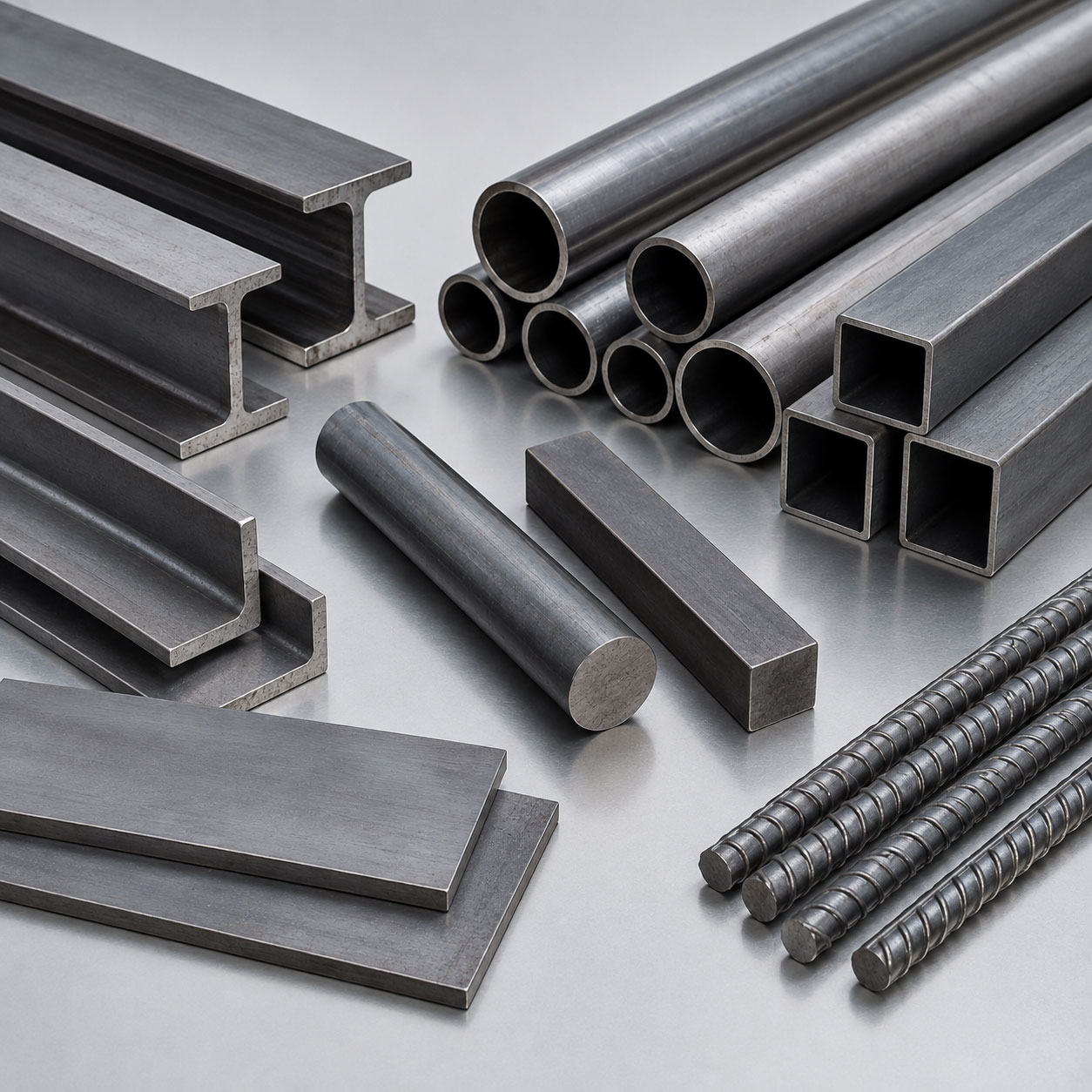
What Is Mild Steel?
Mild steel generally refers to carbon steel containing a relatively low proportion of carbon. Its low-carbon composition normally gives it better ductility, forming capability and weldability than medium- and high-carbon steels.
The term does not define:
- One fixed carbon percentage
- One minimum yield strength
- One product standard
- One surface condition
- One dimensional tolerance
- One guaranteed weldability level
- One corrosion-protection system
A buyer should therefore order against a recognised grade and product specification rather than writing only “MS material required.”
Quick Buyer Answer
| Buyer question | Practical answer |
|---|---|
| What is mild steel? | A general commercial term for low-carbon steel used in structural, fabrication and engineering applications. |
| Is mild steel one grade? | No. It includes multiple grades and product standards. |
| Why is mild steel widely used? | It is generally economical, weldable, formable, machinable and readily fabricated. |
| Is mild steel corrosion resistant? | No. Unprotected mild steel can rust when exposed to moisture and oxygen. |
| Is all mild steel suitable for structural work? | No. Structural steel must meet the grade, strength, toughness and product-standard requirements of the design. |
| What should a buyer specify? | Grade, standard, product form, dimensions, quantity, application, surface condition, testing and delivery location. |
Mild Steel Composition
Iron is the main constituent of mild steel. Carbon is present at a relatively low level, while controlled quantities of manganese, silicon, phosphorus, sulphur and other elements may also be present.
Exact chemical limits depend on the grade and applicable standard.
| Element or factor | General function or concern |
|---|---|
| Carbon | Influences strength, hardness, ductility and weldability |
| Manganese | Supports strength and helps control the effects of sulphur |
| Silicon | May be used during steelmaking and can influence strength |
| Phosphorus | Normally restricted because excessive levels may reduce ductility or toughness |
| Sulphur | Usually controlled; higher levels can affect hot working and weld quality |
| Copper and other residuals | May be limited or reported depending on the specification |
| Microalloying elements | May be present in particular structural or high-strength grades |
How Carbon Content Affects Steel
As carbon content generally increases:
- Strength and hardness can increase
- Wear resistance can improve
- Ductility can decrease
- Severe forming can become more difficult
- Welding may require greater control
- Heat-treatment response can change
Low carbon is one reason mild steel is usually easier to weld and form than higher-carbon steels. Performance still depends on section thickness, processing history, alloying elements and the specified grade.
Main Properties of Mild Steel
Exact property values must be taken from the relevant material certificate and product standard.
| Property | General mild steel behaviour | Why it matters to the buyer |
|---|---|---|
| Strength | Suitable for many structural and general engineering applications | Grade and thickness must match the design load |
| Ductility | Generally good | Supports bending, forming, drawing and fabrication |
| Weldability | Usually good in low-carbon grades | Welding procedure must still suit the grade and thickness |
| Formability | Generally useful | Important for sheets, coils, brackets, panels and enclosures |
| Machinability | Suitable for many general machining operations | Exact grade and condition affect tool life and chip formation |
| Toughness | Grade- and temperature-dependent | Structural and impact-loaded service may require a specified subgrade |
| Hardness | Lower than medium- and high-carbon steel | Supports forming but limits wear resistance |
| Fatigue performance | Depends on grade, design, surface and welded details | Important for cyclically loaded machinery and structures |
| Corrosion resistance | Limited without protection | Coating, galvanising or controlled maintenance may be needed |
| Thermal conductivity | Useful for many equipment and fabrication applications | Actual values vary with composition and temperature |
| Magnetic behaviour | Ferromagnetic | Relevant for lifting, sensing and electromagnetic applications |
| Recyclability | Steel can be recovered and recycled | Supports material recovery and lifecycle planning |
| Cost efficiency | Generally economical compared with many alloyed materials | Makes it suitable for high-volume fabrication |
- Grade
- Thickness
- Hot-rolled or cold-rolled condition
- Cold working
- Normalising or other heat treatment
- Product form
- Manufacturing route
- Surface treatment
Common Mild Steel and Low-Carbon Steel Grades
Grade availability depends on product form, standard, dimensions and required condition.
| Grade or designation | Standard family or market usage | Common buyer consideration |
|---|---|---|
| IS 2062 E250 | Indian hot-rolled structural steel specification | Structural plates, sections, flats and general engineering |
| IS 2062 higher strength grades | Indian structural steel specification | Structures requiring specified higher yield strength |
| ASTM A36/A36M | Carbon structural steel | Structural shapes, plates and bars for welded, bolted or riveted construction |
| EN 10025 S235 | European structural steel | General structural and fabricated components |
| EN 10025 S275 | European structural steel | Structural plates and sections with specified yield strength |
| EN 10025 S355 | Higher-strength structural steel | Structures requiring greater specified yield strength |
| SAE/AISI 1008 | Low-carbon steel family | Formed, stamped and cold-rolled products, depending on product standard |
| SAE/AISI 1010 | Low-carbon steel family | General forming, fabrication and engineering |
| SAE/AISI 1018 | Low-carbon steel family | Bars, shafts, machined components and general engineering |
| IS 513 grades | Cold-reduced low-carbon sheet and strip | Drawing, forming and sheet-metal applications |
| IS 280 | Mild steel wire for general engineering purposes | General-purpose wire applications |
Grades Are Not Automatically Equivalent
IS 2062 E250, ASTM A36, S275 and SAE 1018 should not be treated as direct substitutes merely because they may all be called mild or low-carbon steel.
They can differ in:
- Chemical limits
- Yield strength
- Tensile strength
- Elongation
- Impact requirements
- Deoxidation practice
- Thickness-dependent properties
- Product scope
- Testing
- Certification
- Dimensional requirements
Use the grade stated on the drawing or purchase specification. Any substitution should be approved by the responsible engineer or customer.
Understanding Structural Grade Numbers
Many structural steel designations include a number associated with a specified minimum yield strength under defined conditions.
For example, under EN structural-steel systems:
- S275 identifies a structural steel with a specified yield-strength level
- S355 identifies a higher specified yield-strength level
The applicable minimum value can reduce as material thickness increases. Therefore, a grade name alone is not sufficient when checking load capacity.
The design should use the property value applicable to:
- Exact grade
- Subgrade
- Thickness
- Product form
- Standard edition
- Delivery condition
SteelConstruction.info’s structural-steel reference explains the relationship between structural grade designations, thickness and minimum yield strength.
Mild Steel Product Forms
Solitaire Steel & Engineering LLP can review enquiries across common mild steel product forms, subject to actual availability.
| Product form | Information buyers should specify |
|---|---|
| Mild steel coils | Grade, thickness, width, coil ID/OD, coil weight, surface and edge |
| Mild steel sheets | Grade, thickness, width, length, finish, tolerance and forming requirement |
| Mild steel plates | Grade, thickness, width, length, structural application and testing |
| Mild steel strips | Grade, thickness, width, condition, edge and coil requirement |
| Mild steel round bars | Grade, diameter, length, tolerance and machining requirement |
| Mild steel square bars | Grade, section size, length, tolerance and surface |
| Mild steel flat bars | Width, thickness, length, edge and applicable standard |
| Mild steel pipes | Manufacturing type, nominal size/OD, schedule or wall, length and standard |
| Mild steel tubes | Shape, OD, wall thickness, length, tolerance and application |
| Mild steel angles | Equal or unequal, leg dimensions, thickness, length and grade |
| Mild steel channels | Channel designation, depth, flange, thickness, length and grade |
| Mild steel beams | Section designation, size, mass, length, grade and structural requirement |
| Mild steel hollow sections | RHS, SHS or CHS, dimensions, wall thickness, grade and standard |
| Mild steel wire | Grade, diameter, coil, finish and final use |
| Mild steel fabricated blanks | Drawing, dimensions, tolerance, hole pattern and processing requirement |
Pipe and Tube Buying Note
“MS pipe” is incomplete. Buyers should state:
- Seamless or welded construction
- ERW, SAW or another specified manufacturing route
- Pipe or structural hollow section
- Nominal bore or actual outside diameter
- Schedule or wall thickness
- Length and end preparation
- Pressure, structural or mechanical service
- Product standard
- Testing and coating requirement
Hot-Rolled vs Cold-Rolled Mild Steel
| Selection factor | Hot-rolled mild steel | Cold-rolled or cold-reduced mild steel |
|---|---|---|
| Manufacturing stage | Rolled at elevated temperature | Further reduced after hot rolling |
| Surface | Normally scaled or pickled depending on supply condition | Generally smoother and cleaner |
| Dimensional control | Suitable for structural and general fabrication tolerances | Usually closer dimensional control |
| Strength and hardness | Grade-dependent | Cold working can increase strength and hardness |
| Formability | Suitable for many general forming operations | Depends on grade and drawing quality |
| Typical forms | Plates, structural sections, bars and coils | Sheets, strips and precision-formed products |
| Typical applications | Structures, frames and heavy fabrication | Panels, cabinets, appliances and stamped components |
| Cost | Generally lower | Generally higher due to additional processing |
Do not select solely by appearance. The forming process, tolerance, finish and mechanical requirements should determine the product.
Pickled and Oiled Mild Steel
Hot-rolled pickled and oiled steel has surface scale removed, followed by oil protection.
It may be considered when buyers need:
- A cleaner surface than standard hot-rolled material
- Improved readiness for fabrication
- Reduced loose scale
- A surface suitable for further processing
- Temporary protection during handling and storage
The oil film is not a permanent corrosion-protection system. Storage conditions and further coating should still be planned.
Galvanised Mild Steel
Galvanising adds a zinc coating to protect the underlying steel against corrosion.
Common applications include:
- Roofing
- Cable trays
- Ducting
- Fencing
- Outdoor fabricated components
- Structural accessories
- Automotive components
- Equipment enclosures
Buyers should specify:
- Base steel grade
- Coating standard
- Zinc coating mass or thickness
- Surface and spangle requirement
- Forming operation
- Welding requirement
- Final environment
Galvanised steel is not suitable for every chemical or high-temperature environment.
Major Applications of Mild Steel
Structural Construction
Mild and structural carbon steels are used for:
- Building frames
- Roof structures
- Platforms
- Walkways
- Staircases
- Trusses
- Brackets
- Support frames
- Industrial sheds
- General structural fabrication
The structural designer must specify the grade, section, load criteria, connection design and corrosion protection.
Machinery and Equipment
Common uses include:
- Machine bases
- Frames
- Guards
- Mounting plates
- Covers
- Brackets
- Shafts
- Fixtures
- Fabricated housings
- General machined components
Where wear, fatigue or high hardness is required, a different grade or surface treatment may be necessary.
Automotive and Transport
Mild steel may be used for:
- Body panels
- Chassis components
- Brackets
- Frames
- Wheels
- Mounting parts
- Transport containers
- Trailers
- General formed components
Automotive grades are selected against forming, fatigue, crash, surface and joining requirements—not merely the “MS” description.
Pipes and Fluid Systems
Selected carbon-steel pipes are used for:
- Water lines
- Fire-protection systems
- Low- and medium-pressure services
- Process piping
- Air lines
- General industrial pipelines
- Structural tubular fabrication
The fluid, pressure, temperature, corrosion allowance, standard, coating and inspection requirements must be specified.
Storage Tanks and Vessels
Mild or carbon steel may be used for:
- Water tanks
- Oil tanks
- Storage bins
- Hoppers
- Silos
- Process vessels
- Fabricated containers
Pressure vessels and regulated tanks require an approved pressure-vessel material specification. General structural mild steel should not be substituted without design approval.
Sheet-Metal Fabrication
Common products include:
- Electrical panels
- Cabinets
- Equipment covers
- Ducts
- Trays
- Boxes
- Brackets
- Furniture parts
- Appliance components
- General pressings
Sheet grade, drawing quality, bend radius, surface and flatness can be more important than a generic strength description.
Agricultural Equipment
Mild steel is widely considered for:
- Frames
- Implements
- Trailers
- Fencing
- Storage equipment
- Guards
- Structural supports
- Repair and maintenance components
Outdoor exposure normally requires painting, galvanising or another protective system.
Furniture and Interior Fabrication
Applications include:
- Tables
- Chairs
- Racks
- Shelving
- Frames
- Partitions
- Display fixtures
- Decorative fabricated parts
Surface preparation affects paint, powder-coating and final appearance.
Electrical and Utility Applications
Possible applications include:
- Cable trays
- Equipment enclosures
- Mounting frames
- Poles
- Support brackets
- Earthing-related components
- Transformer and motor laminations using specialised electrical steel
Specialised electrical steel should not be replaced with general mild steel.
Fasteners and Wire Products
Low-carbon steel may be used for:
- Nails
- Screws
- Rivets
- General fasteners
- Wire mesh
- Fencing wire
- Tie wire
- Formed wire products
The exact wire or fastener grade, strength class and coating must be confirmed.
Mild Steel Fabrication Properties
Welding
Low-carbon steel is generally weldable using common industrial welding processes. However, successful welding still depends on:
- Carbon equivalent
- Material thickness
- Joint restraint
- Welding process
- Filler selection
- Preheat requirement
- Heat input
- Hydrogen control
- Service temperature
- Applicable welding code
ASTM A36/A36M states that when the steel is welded, a procedure suitable for the grade and intended service should be used. ASTM A36/A36M scope
Forming and Bending
Mild steel generally provides useful forming behaviour, but minimum bend radius and risk of cracking depend on:
- Grade
- Thickness
- Rolling direction
- Edge quality
- Surface defects
- Forming speed
- Tool geometry
- Temperature
- Previous cold work
Machining
Mild steel can be turned, milled, drilled, tapped and cut. Machining response depends on composition, inclusion control, hardness and condition.
Very low-carbon material may produce less-controlled chips than a purpose-selected free-machining grade.
Cutting
Common processes include:
- Saw cutting
- Shearing
- Laser cutting
- Plasma cutting
- Oxy-fuel cutting
- Waterjet cutting
Heat-affected edges, taper, burr, scale and machining allowance should be considered when ordering cut parts.
Coating
Common protection systems include:
- Primer and paint
- Powder coating
- Hot-dip galvanising
- Electroplating
- Metal spraying
- Temporary oil protection
Coating selection depends on surface preparation, environment, intended life and maintenance access.
Corrosion Behaviour of Mild Steel
Mild steel does not form the same protective chromium-rich passive layer as stainless steel. When exposed to moisture and oxygen, it can develop iron oxide or rust.
Corrosion may be accelerated by:
- Coastal salt
- High humidity
- Chemicals
- Acidic or alkaline exposure
- Water retention
- Crevices
- Damaged coating
- Dissimilar-metal contact
- Poor drainage
- Contaminated soil
- Elevated temperature
Corrosion-Control Options
| Protection method | General use | Buyer consideration |
|---|---|---|
| Painting | Indoor and outdoor structures | Surface preparation and maintenance are critical |
| Powder coating | Fabricated parts and equipment | Damage can expose the underlying steel |
| Hot-dip galvanising | Outdoor structures and components | Venting, drainage and coating thickness must be considered |
| Electroplating | Small components and decorative parts | Coating type and thickness depend on service |
| Corrosion allowance | Tanks, structures and industrial service | Must be set by the designer |
| Cathodic protection | Pipelines, tanks and submerged structures | Requires engineered system design |
| Weathering-steel selection | Suitable atmospheric structures | Weathering steel is not ordinary mild steel and needs the correct environment |
| Material upgrade | Aggressive or hygienic service | Stainless or another corrosion-resistant material may be more suitable |
Advantages of Mild Steel
- Generally economical
- Good weldability in suitable low-carbon grades
- Useful ductility and formability
- Suitable for common machining operations
- Available in many product forms
- Compatible with multiple cutting and joining methods
- Can be painted, plated, galvanised or powder coated
- Suitable for construction and general engineering
- Recyclable
- Familiar to fabricators and engineering contractors
- Broad range of grades and standards
- Practical for high-volume manufacturing
These benefits depend on correct grade and product selection.
Limitations of Mild Steel
Limited Natural Corrosion Resistance
Bare mild steel can rust. Exposure and maintenance must be considered from the design stage.
Lower Hardness and Wear Resistance
General mild steel may not suit cutting edges, gears, dies or severe abrasion without upgrading the grade or applying a surface treatment.
Lower Strength Than High-Strength Steel
Increasing section thickness to achieve load capacity can add weight. Higher-strength structural steel may sometimes reduce section size, subject to design.
Limited High-Temperature Strength
Mild steel loses strength as temperature rises. Fire and elevated-temperature applications require code-based design and protection.
Grade Ambiguity
The term “mild steel” does not establish certified properties. Ordering only by this name can lead to incorrect material supply.
Surface Scale
Hot-rolled products may carry mill scale. Blasting, pickling, grinding or another preparation may be needed before coating.
Dimensional Tolerances Vary
Plate, sheet, bar, tube and structural sections follow different tolerance standards.
Not Suitable for Every Pressure Application
Pressure piping, boilers and pressure vessels require specific approved material standards.
Welding Is Not Automatically Risk-Free
Thick sections, restrained joints, low service temperatures and higher carbon-equivalent grades may require controlled welding procedures.
Mild Steel vs Stainless Steel
| Selection factor | Mild steel | Stainless steel |
|---|---|---|
| Main alloy system | Low-carbon iron-based steel | Chromium-containing corrosion-resistant steel |
| Natural corrosion resistance | Low | Higher, depending on grade |
| Initial cost | Generally lower | Generally higher |
| Painting or coating | Commonly required | May not be required in many environments |
| Weldability | Generally good in suitable grades | Grade-dependent; many austenitic grades weld well |
| Strength | Grade-dependent | Grade- and family-dependent |
| Hygiene and cleanability | Usually requires coating or controlled surface | Often preferred for sanitary service |
| High-temperature options | Special carbon or alloy grades required | Several stainless heat-resistant grades available |
| Maintenance | Coating inspection and repair may be required | Depends on grade, finish and exposure |
| Typical selection reason | Economy, fabrication and structural use | Corrosion, hygiene, appearance or temperature |
Use lifecycle cost rather than purchase price alone when corrosion or maintenance is important.
Mild Steel vs Medium-Carbon Steel
| Selection factor | Mild/low-carbon steel | Medium-carbon steel |
|---|---|---|
| Carbon level | Relatively low | Higher |
| Ductility | Generally higher | Generally lower |
| Weldability | Generally easier | Requires more control |
| Heat-treatment response | Limited compared with higher-carbon grades | Better hardening response |
| Strength and hardness | Lower | Higher potential |
| Wear resistance | Limited | Better after suitable treatment |
| Common uses | Structures, sheets, frames and general fabrication | Shafts, axles, gears and machinery parts |
| Formability | Generally better | More limited |
Where hardness and wear are important, a medium-carbon or alloy steel may be more suitable than mild steel.
Mild Steel vs High-Strength Low-Alloy Steel
| Selection factor | Conventional mild steel | HSLA steel |
|---|---|---|
| Strength | Moderate | Higher |
| Section weight | May require thicker sections | May allow reduced thickness after design |
| Alloy additions | Generally limited | Controlled microalloying may be used |
| Formability | Generally good | Grade-dependent |
| Welding | Usually straightforward | Procedure must consider grade and strength |
| Cost per tonne | Generally lower | Often higher |
| Total fabricated cost | Depends on section and processing | Weight saving may offset material cost |
| Typical selection | General structures and fabrication | Weight-sensitive or higher-strength structures |
Higher strength does not automatically improve stiffness because the elastic modulus is broadly similar across common structural steels.
Mild Steel vs Cast Iron
| Selection factor | Mild steel | Cast iron |
|---|---|---|
| Manufacturing route | Rolled, forged, drawn or fabricated products | Cast into shape |
| Ductility | Generally higher | Usually lower |
| Weldability | Generally better | Often difficult |
| Impact resistance | Generally better | Grade-dependent and often more brittle |
| Compressive performance | Good | Often very good |
| Complex shapes | Fabrication required | Can be cast directly |
| Typical applications | Structures, frames, sheets, pipes and machinery | Machine beds, housings, covers and cast components |
How to Select the Right Mild Steel
1. Identify the Final Application
Is the material required for:
- Structural work
- Sheet-metal forming
- Pressure service
- Machining
- General fabrication
- Automotive components
- Tanks
- Pipes
- Furniture
- Outdoor structures
2. Confirm the Required Grade and Standard
Do not ask the supplier to infer a structural or pressure grade from the term “MS.”
3. Define the Mechanical Requirement
Confirm:
- Minimum yield strength
- Tensile-strength range
- Elongation
- Impact toughness
- Hardness
- Fatigue or cyclic loading
- Service temperature
4. Define the Product Form and Condition
Specify:
- Hot rolled or cold rolled
- Plate, sheet, coil, pipe, bar or section
- Pickled and oiled
- Galvanised
- Normalised or as rolled
- Welded or seamless pipe
- Cut size or full size
5. Define Fabrication Requirements
State whether the product will be:
- Welded
- Bent
- Deep drawn
- Machined
- Galvanised
- Painted
- Laser cut
- Flame cut
- Subjected to heat treatment
Practical Selection Guide
| Buyer requirement | Material direction to evaluate |
|---|---|
| General structural fabrication in India | Suitable IS 2062 grade and subgrade |
| Structural work to ASTM specification | ASTM A36 or another design-specified grade |
| European structural project | S235, S275, S355 or design-specified grade |
| Deep-drawn sheet component | Suitable drawing-quality cold-reduced sheet grade |
| General machined bar | SAE/AISI 1018 or another specified bar grade |
| Cabinet or enclosure | Cold-rolled sheet with specified finish and tolerance |
| Outdoor fabricated structure | Structural grade plus suitable corrosion protection |
| Pressure pipe | Approved pressure-pipe grade and product standard |
| Water or chemical tank | Grade selected for pressure, corrosion and lining system |
| High-wear component | Medium-carbon, alloy or abrasion-resistant steel |
| Weight-sensitive structure | Compare conventional structural steel with HSLA |
| Hygienic or aggressive chemical application | Consider stainless or another corrosion-resistant material |
This table is preliminary buying guidance, not an engineering approval.
Standards and Documentation to Confirm
The product specification depends on whether the requirement is for sheet, plate, bar, pipe, tube, wire or structural sections.
Buyers may specify:
- Grade
- Product standard
- Steelmaking or delivery condition
- Chemical composition
- Carbon equivalent, when relevant
- Yield and tensile properties
- Elongation
- Impact test and test temperature
- Dimensions and tolerance
- Surface condition
- Coating
- Heat or batch number
- Material test certificate
- Ultrasonic testing
- Hydrostatic testing
- Weld inspection
- Third-party inspection, if contractually required
- Packing and marking
Information Required for an Accurate Mild Steel Quotation
| Required information | Example |
|---|---|
| Grade | IS 2062 E250, ASTM A36, S275 or SAE 1018 |
| Product form | Plate, sheet, coil, bar, pipe, tube or section |
| Manufacturing condition | Hot rolled, cold rolled, pickled and oiled or galvanised |
| Dimensions | Thickness × width × length or OD × wall × length |
| Quantity | Pieces, metres, kilograms or tonnes |
| Standard | IS, ASTM, EN, SAE or customer specification |
| Structural subgrade | State impact or subgrade requirement where applicable |
| Surface | Mill finish, pickled and oiled, galvanised or coated |
| Tolerance | Standard or special tolerance |
| Fabrication | Welding, bending, machining, drawing or cutting |
| Application | Structure, machinery, tank, pipework or sheet-metal component |
| Testing | Mechanical, impact, UT, hydrotest or another specified test |
| Documentation | MTC, traceability and inspection requirement |
| Processing | Full size, cut size, blank or drawing-based part |
| Delivery | City, country, port and required date |
Enquire with Solitaire Steel & Engineering LLP
Solitaire Steel & Engineering LLP, Mumbai, India, accepts domestic and export enquiries for mild steel and carbon steel products in different grades and forms.
Buyers can submit requirements for:
- Mild steel sheets and plates
- Mild steel coils and strips
- Mild steel round, square and flat bars
- Mild steel pipes and tubes
- Mild steel angles, channels and beams
- Mild steel hollow sections
- Mild steel wire
- Drawing-based cut requirements
Final grade, size, stock, sourcing, processing, coating, tolerance, testing, certification, packing and delivery must be confirmed against the enquiry.
Request a quotation: Send the complete grade, product form, dimensions, quantity, standard, application, documentation and delivery location for a requirement-based response.