

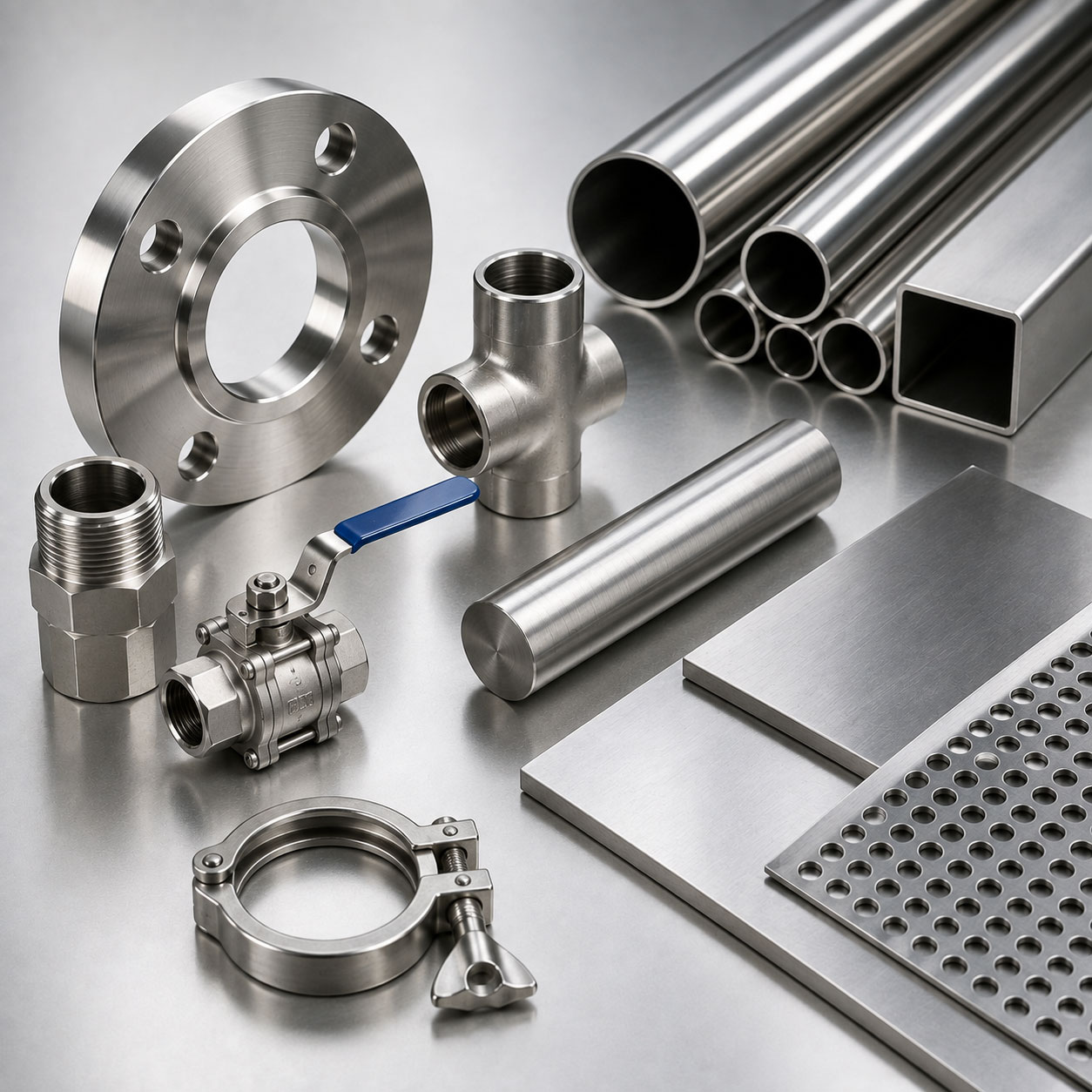
What Is Stainless Steel?
Stainless steel is an iron-based alloy containing sufficient chromium to develop a thin, protective oxide layer on its surface. This passive layer helps resist corrosion and can reform when adequate oxygen is available.
Stainless steel is not one material with one fixed property set. It includes numerous grades belonging to different metallurgical families:
- Austenitic stainless steel
- Ferritic stainless steel
- Martensitic stainless steel
- Duplex stainless steel
- Precipitation-hardening stainless steel
The grade must be selected according to the actual exposure, temperature, load, fabrication process and governing specification.
Quick Buyer Answer
| Buyer question | Practical answer |
|---|---|
| What makes stainless steel corrosion resistant? | Chromium helps form a protective passive film on the surface. |
| Does every stainless steel grade perform equally? | No. Corrosion resistance, strength, magnetism, weldability and temperature capability vary considerably. |
| Which is the most commonly specified grade? | Grade 304 is widely used for general fabrication, but it is not suitable for every environment. |
| When is 316 preferred over 304? | 316 is commonly evaluated where chlorides, salt, chemicals or more aggressive exposure are present. |
| Is stainless steel completely rust-proof? | No. Incorrect grade selection, chlorides, contamination, poor fabrication or unsuitable service conditions can cause corrosion. |
| What information should a buyer provide? | Grade, product form, size, quantity, standard, finish, application, environment and documentation requirements. |
How Stainless Steel Resists Corrosion
Chromium in stainless steel reacts with oxygen and forms a very thin, adherent passive layer. This layer separates the underlying metal from the surrounding environment.
The passive film can protect the surface only when:
- The selected grade suits the environment
- Fabrication contamination is controlled
- The surface is properly cleaned
- Oxygen is available for repassivation
- Chloride concentration and temperature remain within acceptable limits
- Crevices, deposits and stagnant conditions are considered
- Welding and heat treatment are performed correctly
Elements such as nickel, molybdenum and nitrogen may be added to obtain different combinations of corrosion resistance, strength, formability and microstructure.
Main Properties of Stainless Steel
The exact values must be taken from the applicable grade and product standard. The following table explains the properties from a purchasing perspective.
| Property | General stainless steel behaviour | Why it matters to the buyer |
|---|---|---|
| Corrosion resistance | Varies from general atmospheric resistance to performance in aggressive chemical or chloride environments | Determines grade suitability and expected service life |
| Strength | Depends on grade, heat treatment and cold working | Affects thickness, load capacity and component design |
| Ductility | Austenitic grades generally provide good ductility | Important for bending, drawing, spinning and pressing |
| Toughness | Grade- and temperature-dependent | Critical for impact, low-temperature and safety-related service |
| Hardness | Varies widely between families and conditions | Influences wear, machining and forming |
| Heat resistance | Certain grades resist oxidation and retain strength at elevated temperatures | Required for furnaces, heaters and hot-process equipment |
| Low-temperature performance | Austenitic grades often retain useful toughness at low temperatures | Important for cryogenic or refrigerated equipment |
| Weldability | Generally good in many austenitic grades; more controlled in other families | Influences fabrication method, filler selection and post-weld treatment |
| Machinability | Often lower than free-machining carbon steels | Affects tool choice, speed, feed and production cost |
| Formability | Particularly useful in many austenitic grades | Important for tanks, sinks, panels and formed components |
| Surface finish | Can be supplied or processed in several finishes | Affects hygiene, appearance, cleanability and corrosion performance |
| Magnetic response | Depends on microstructure and processing | Important for separation, sensing, electrical and equipment applications |
| Hygiene and cleanability | Smooth, correctly finished surfaces are easy to clean | Valuable in food, pharmaceutical and sanitary applications |
| Recyclability | Stainless steel can be recovered and recycled | Supports material recovery and lifecycle planning |
Five Main Stainless Steel Families
1. Austenitic Stainless Steel
Austenitic stainless steels are widely used because they offer a practical combination of corrosion resistance, formability, toughness and weldability.
Common grades include:
- Stainless Steel 202
- Stainless Steel 304
- Stainless Steel 304L
- Stainless Steel 316
- Stainless Steel 316L
- Stainless Steel 310
- Stainless Steel 321
- Stainless Steel 317
Typical buyer considerations:
- Good general fabrication capability
- Useful corrosion resistance
- Good forming and drawing behaviour in many grades
- Generally non-magnetic in the annealed condition
- Can become partly magnetic after cold working
- Cannot normally be hardened through conventional heat treatment
- Can gain strength through cold working
2. Ferritic Stainless Steel
Ferritic stainless steels contain chromium as their main stainless-forming alloying element and normally contain little or no nickel.
A common commercial example is Stainless Steel 430.
Typical buyer considerations:
- Magnetic
- Useful resistance in mild atmospheric and indoor environments
- Lower thermal expansion than many austenitic grades
- Commonly evaluated for appliances, trim and decorative components
- Formability and weldability depend on grade and thickness
- Generally not selected for severe chloride exposure
3. Martensitic Stainless Steel
Martensitic stainless steels can be hardened through heat treatment. They are used when hardness, strength or wear resistance is more important than the corrosion resistance offered by common austenitic grades.
Common examples include 410, 420 and 431.
Typical buyer considerations:
- Magnetic
- Heat-treatable
- Capable of higher hardness
- Used for shafts, blades, valves and wear components
- Welding requires greater control
- Corrosion resistance is generally more limited than 304 or 316
4. Duplex Stainless Steel
Duplex stainless steels contain a mixed austenitic-ferritic microstructure. They combine higher strength with useful resistance to several forms of corrosion.
Common examples include Duplex 2205 and Super Duplex 2507.
Typical buyer considerations:
- Higher strength than common austenitic grades
- Magnetic
- Useful chloride stress-corrosion cracking resistance
- Considered for marine, chemical, offshore and process applications
- Welding and heat input must be controlled
- Material selection should consider service temperature and fabrication route
5. Precipitation-Hardening Stainless Steel
Precipitation-hardening grades can develop high strength through controlled heat treatment.
A common example is 17-4 PH.
Typical buyer considerations:
- High strength
- Useful corrosion resistance for many engineering environments
- Heat-treatment condition must be stated
- Used for shafts, aerospace parts, valves and precision components
- Mechanical properties vary with the specified treatment condition
Stainless Steel Family Comparison
| Family | General corrosion resistance | Strength | Formability | Weldability | Magnetic response | Common selection reason |
|---|---|---|---|---|---|---|
| Austenitic | Good to high, depending on grade | Moderate; increases with cold work | Generally excellent | Generally good | Usually low in annealed condition | General fabrication and corrosion resistance |
| Ferritic | Moderate to good in suitable environments | Moderate | Moderate | Grade-dependent | Magnetic | Appliances, trim and cost-sensitive applications |
| Martensitic | Moderate | High after heat treatment | Limited compared with austenitic grades | Requires control | Magnetic | Hardness, wear and cutting applications |
| Duplex | High in suitable environments | High | Moderate | Good with controlled procedures | Magnetic | Strength and chloride resistance |
| Precipitation hardening | Good, grade-dependent | Very high after treatment | Condition-dependent | Grade-dependent | Usually magnetic | High-strength precision components |
This is preliminary guidance. The exact grade, condition and standard govern performance.
Common Stainless Steel Grades and Their Applications
Stainless Steel 202
Grade 202 is an austenitic stainless steel in which manganese and nitrogen replace part of the nickel used in conventional 300-series grades.
Commonly evaluated for:
- Indoor architectural components
- Kitchen and household equipment
- Decorative fabrication
- Railings
- General sheet-metal work
- Furniture components
Selection caution: Grade 202 should not automatically replace 304 in corrosive, humid, marine or chemically aggressive service. Application, exposure and finish must be assessed.
Stainless Steel 304
Grade 304 is a widely used austenitic grade offering a balanced combination of corrosion resistance, fabrication capability and availability.
Commonly evaluated for:
- Food-processing equipment
- Kitchen equipment
- Tanks and vessels
- Architectural components
- General engineering
- Pipework
- Fabricated enclosures
- Pharmaceutical equipment
- Dairy equipment
Selection caution: 304 may experience pitting or crevice corrosion in chloride-bearing environments.
Stainless Steel 304L
304L is a lower-carbon version of 304. It is commonly selected for welded fabrication where resistance to sensitisation-related intergranular corrosion is important.
Commonly evaluated for:
- Welded tanks
- Process piping
- Fabricated vessels
- Chemical equipment
- Food-processing systems
- Pharmaceutical equipment
Buyer consideration: Do not assume every 304 product is automatically certified as 304L. Confirm the exact material certificate and applicable standard.
Stainless Steel 316
Grade 316 contains molybdenum and is commonly selected where improved resistance to pitting and crevice corrosion is needed compared with 304.
Commonly evaluated for:
- Chemical processing
- Coastal equipment
- Marine-related components
- Pharmaceutical systems
- Food and beverage equipment
- Laboratory equipment
- Industrial pipework
- Heat-exchanger components
Selection caution: 316 is not immune to seawater corrosion. Temperature, chloride concentration, crevices and flow conditions remain important.
Stainless Steel 316L
316L is the lower-carbon version of 316 and is widely used in welded equipment exposed to corrosive service.
Commonly evaluated for:
- Welded chemical tanks
- Pharmaceutical vessels
- Sanitary pipework
- Marine-related fabrication
- Food-processing equipment
- Process plants
- Water-treatment equipment
Buyer consideration: Surface finish, welding procedure, cleaning and passivation can be as important as the grade.
Stainless Steel 310
Grade 310 is a high-chromium, high-nickel austenitic grade commonly evaluated for elevated-temperature and oxidation-resistant applications.
Commonly evaluated for:
- Furnace components
- Heat-treatment equipment
- Burner parts
- Kiln components
- Heat shields
- High-temperature process equipment
Selection caution: Temperature capability depends on load, atmosphere, thermal cycling and applicable design code. A heat-resistant grade is not automatically suitable for every corrosive environment.
Stainless Steel 321
Grade 321 is a titanium-stabilised austenitic stainless steel used where resistance to sensitisation during elevated-temperature exposure or welding is required.
Commonly evaluated for:
- High-temperature pipework
- Expansion joints
- Exhaust components
- Heat exchangers
- Thermal-processing equipment
- Welded components exposed to elevated temperatures
Buyer consideration: Compare 321 with 304L based on service temperature, welding, fabrication and governing specification.
Stainless Steel 317
Grade 317 contains more molybdenum than standard 316 and may be considered for more demanding corrosive environments.
Commonly evaluated for:
- Chemical-processing equipment
- Pulp and paper equipment
- Process tanks
- Industrial piping
- Selected acid-handling environments
Selection caution: The actual chemical concentration, temperature, aeration and contamination must be checked before selection.
Stainless Steel 430
Grade 430 is a magnetic ferritic stainless steel used for decorative, appliance and mildly corrosive applications.
Commonly evaluated for:
- Appliance panels
- Kitchen-equipment components
- Automotive trim
- Interior architectural elements
- Decorative sheets
- Equipment housings
Selection caution: 430 does not provide the same corrosion resistance, formability or weldability as common 300-series grades.
Buyer Comparison of Common Grades
| Selection point | 202 | 304/304L | 316/316L | 310 | 321 | 317 | 430 |
|---|---|---|---|---|---|---|---|
| Family | Austenitic | Austenitic | Austenitic | Austenitic | Austenitic | Austenitic | Ferritic |
| General corrosion resistance | Suitable for selected mild environments | Good general-purpose performance | Improved chloride resistance over 304 | Grade selected mainly for heat resistance | Similar general family to 304, with stabilisation | Greater molybdenum content than 316 | Suitable for mild environments |
| Welded fabrication | Application-dependent | 304L often preferred | 316L often preferred | Requires temperature-aware design | Commonly evaluated for elevated-temperature welded service | Application-dependent | Requires grade-appropriate control |
| Elevated temperature | Not a primary selection reason | Limited by application | Limited by application | Common selection reason | Commonly evaluated | Application-dependent | Selected grades may serve specific heat applications |
| Magnetic response | Usually low when annealed | Usually low when annealed | Usually low when annealed | Usually low when annealed | Usually low when annealed | Usually low when annealed | Magnetic |
| Typical buying reason | Cost-sensitive indoor/general use | General fabrication | More demanding corrosion exposure | Oxidation and heat resistance | Stabilised high-temperature service | Demanding process environments | Decorative and appliance use |
Use this table only for preliminary comparison. Final material approval must follow the applicable specification and service data.
Stainless Steel Product Forms
Solitaire Steel & Engineering LLP can review requirements across the following forms, subject to grade, dimensions and availability.
| Product form | Buyer information to specify |
|---|---|
| Stainless steel coils | Grade, thickness, width, coil ID/OD, coil weight, finish and edge |
| Stainless steel sheets | Grade, thickness, width, length, finish, tolerance and protective film |
| Stainless steel plates | Grade, thickness, width, length, surface, flatness and inspection |
| Stainless steel blocks | Grade, dimensions, machining allowance and testing requirement |
| Stainless steel ERW pipes | Grade, OD or nominal bore, wall/schedule, length, standard and end condition |
| Stainless steel seamless pipes | Grade, OD, wall/schedule, length, pressure standard and testing |
| Stainless steel semi-seamless tubes | Exact manufacturing and product specification must be defined by the buyer |
| Stainless steel tubes | Grade, OD, wall thickness, length, tolerance, finish and service |
| Stainless steel round bars | Grade, diameter, length, condition, tolerance and finish |
| Stainless steel square bars | Grade, section size, length, tolerance and surface |
| Stainless steel flat bars | Width, thickness, length, edge, finish and dimensional tolerance |
| Stainless steel wire | Grade, diameter, condition, coil format, surface and application |
| Stainless steel strips | Grade, thickness, width, hardness, edge and finish |
Important Pipe and Tube Note
“Pipe” and “tube” are not interchangeable purchasing descriptions. A buyer should state:
- Seamless, welded or another specified construction
- Pipe or tube standard
- Nominal pipe size or actual OD
- Schedule or wall thickness
- Dimensional tolerance
- Pressure or structural service
- Testing and inspection requirement
Major Applications of Stainless Steel
Food, Dairy and Beverage Equipment
Stainless steel is widely considered for:
- Storage tanks
- Mixing vessels
- Processing tables
- Dairy pipelines
- Food-contact surfaces
- Brewery equipment
- Kitchen equipment
- Cleaning systems
Grade, surface roughness, weld finish, cleanability and food-contact compliance must be confirmed.
Pharmaceutical and Biotechnology Equipment
Common applications include:
- Process vessels
- Purified-water systems
- Sanitary piping
- Reactor components
- Laboratory equipment
- Cleanroom furniture
- Storage and transfer equipment
For hygienic service, the complete specification may include finish, weld documentation, traceability, cleaning, passivation and inspection criteria.
Chemical and Process Industries
Stainless steel may be used for:
- Tanks
- Reactors
- Pipework
- Heat exchangers
- Scrubbers
- Agitators
- Valves and fittings
- Process vessels
Chemical name alone is insufficient for grade selection. Concentration, temperature, impurities, aeration, pressure and cleaning chemicals should be provided.
Architecture and Construction
Applications include:
- Cladding
- Railings
- Handrails
- Roofing
- Structural components
- Façade details
- Decorative panels
- Fasteners
- Interior trim
Location, coastal exposure, surface finish, cleaning access and risk of dissimilar-metal contact influence grade selection.
Marine and Coastal Applications
Suitable grades may be considered for:
- Coastal railings
- Marine fittings
- Boat components
- Offshore equipment
- Seawater-handling systems
- Coastal architectural elements
No common stainless steel grade should be described as universally “marine-proof.” Direct seawater immersion, splash zones, stagnant crevices and high temperatures require careful engineering.
Oil, Gas and Petrochemical Equipment
Possible applications include:
- Process piping
- Valves
- Flanges
- Pressure vessels
- Heat exchangers
- Instrument tubing
- Offshore components
Grade selection may require evaluation of chlorides, sour service, pressure, temperature and project-specific specifications.
Power and High-Temperature Equipment
Stainless steel is used in:
- Boilers
- Furnaces
- Exhaust systems
- Heat shields
- Burner components
- Thermal-processing equipment
- Power-plant pipework
Oxidation resistance and load-bearing strength at temperature are separate properties and both must be checked.
Water Treatment and Desalination
Applications include:
- Piping
- Tanks
- Screens
- Pumps
- Filter components
- Treatment equipment
- Desalination systems
Chloride level, temperature, disinfection chemicals, flow and crevice conditions influence selection.
Automotive and Transport
Stainless steel may be evaluated for:
- Exhaust components
- Trim
- Fuel-system parts
- Transport tanks
- Rail components
- Vehicle fasteners
- Structural and decorative parts
Grade selection depends on heat, corrosion, forming, fatigue and weight requirements.
General Engineering and Manufacturing
Other uses include:
- Shafts
- Fasteners
- Machine components
- Springs
- Enclosures
- Guards
- Fabricated frames
- Instrument parts
- Wire products
Stainless Steel Corrosion Types Buyers Must Consider
Pitting Corrosion
Pitting creates localised holes, often in chloride-bearing environments. Molybdenum-bearing grades such as 316 may offer better resistance than 304, but no grade should be selected without considering chloride level and temperature.
Crevice Corrosion
Narrow gaps beneath gaskets, deposits, washers or overlapping joints can become more aggressive than exposed surfaces. Component design and grade selection are both important.
Intergranular Corrosion
Incorrect thermal exposure or welding can reduce corrosion resistance near grain boundaries. Low-carbon or stabilised grades may be specified for particular welded or elevated-temperature applications.
Stress-Corrosion Cracking
The combination of tensile stress, temperature and a specific corrosive environment can produce cracking. Chloride stress-corrosion cracking is an important consideration for austenitic grades.
Galvanic Corrosion
Electrical contact between dissimilar metals in an electrolyte can accelerate corrosion of the less-noble material. Joint design and isolation may be required.
General Corrosion
Some acids and chemicals can attack the surface relatively uniformly. Chemical compatibility must be assessed using actual concentration and temperature.
Rouging, Tea Staining and Surface Contamination
Discolouration does not always indicate structural failure, but it can show contamination or unsuitable environmental performance. Carbon-steel tools, grinding dust and poor cleaning can contaminate stainless surfaces.
Advantages of Stainless Steel
- Wide range of corrosion-resistant grades
- Good strength-to-section performance
- Suitable for many hygienic applications
- Useful high- and low-temperature options
- Multiple sheet, plate, pipe, tube, bar and wire forms
- Variety of decorative and functional finishes
- Good fabrication potential in selected grades
- Long service life when correctly selected and maintained
- Recyclable at the end of service
- Reduced need for applied coatings in many applications
These advantages are grade- and application-dependent.
Limitations of Stainless Steel
It Is Not Completely Rust-Proof
Chlorides, crevices, deposits, contamination and unsuitable cleaning can damage the passive surface.
Initial Cost Can Be Higher
Stainless steel may cost more initially than carbon steel. Lifecycle cost should consider maintenance, coating, cleaning, replacement and downtime.
Machining Can Be More Demanding
Many stainless grades work-harden and retain heat near the cutting edge. Suitable tooling, rigid setup and controlled feeds are required.
Forming Forces May Be Higher
Austenitic grades can work-harden rapidly, increasing press loads and springback.
Welding Can Change Local Properties
Heat tint, sensitisation, distortion, phase balance or reduced corrosion resistance can result from unsuitable welding procedures.
Surface Finish Affects Performance
Rough surfaces, embedded contamination and uncleaned welds can reduce cleanability and corrosion resistance.
Grade Substitution Can Cause Failure
202, 304, 316, 430 and duplex grades are not interchangeable merely because they all carry the “stainless steel” description.
Magnet Testing Cannot Reliably Identify the Grade
Some stainless steels are magnetic, while austenitic grades can become partly magnetic after cold working. A handheld magnet cannot confirm chemical composition or material certification.
Stainless Steel vs Carbon Steel
| Selection factor | Stainless steel | Carbon steel |
|---|---|---|
| Corrosion resistance | Inherent resistance varies by grade | Usually requires coating or protection |
| Initial material cost | Generally higher | Generally lower |
| Surface maintenance | Can be lower when correctly selected | Coating maintenance may be required |
| Grade range | Multiple corrosion- and heat-resistant families | Broad structural and engineering grades |
| Fabrication | Requires stainless-specific controls | Often familiar and economical |
| Surface contamination | Must be protected from carbon-steel contamination | Less sensitive to this particular issue |
| Appearance | Can provide a durable finished surface | Usually painted, coated or allowed to weather |
| Typical selection basis | Lifecycle, hygiene, corrosion or temperature | Cost, strength and conventional construction |
The correct choice depends on total service requirements rather than material price alone.
304 vs 316 Stainless Steel
| Selection point | Stainless Steel 304 | Stainless Steel 316 |
|---|---|---|
| General use | Widely used general-purpose grade | Used for more demanding corrosion exposure |
| Molybdenum | Not intentionally added in the standard grade | Contains molybdenum |
| Chloride resistance | More limited | Generally better |
| Indoor fabrication | Common choice | May be unnecessary unless exposure demands it |
| Coastal or chemical service | Requires careful evaluation | Commonly evaluated, but not automatically sufficient |
| Cost | Generally lower | Generally higher |
| Welded alternative | 304L | 316L |
Choose 316 or 316L only when the environment justifies it. Conversely, do not select 304 merely to reduce cost when chloride or chemical exposure makes it unsuitable.
304 vs 304L and 316 vs 316L
The L suffix identifies a lower-carbon version.
| Selection factor | Standard-carbon grade | L grade |
|---|---|---|
| Examples | 304, 316 | 304L, 316L |
| Carbon limit | Higher permitted limit | Lower permitted limit |
| Welded fabrication | May require closer consideration | Commonly preferred for welded structures |
| Intergranular-corrosion concern | Depends on thermal exposure | Lower carbon reduces sensitisation risk |
| Elevated-temperature strength | Can differ | Must be checked separately |
| Certification | Must match the purchase specification | Verify actual certificate, not only a supplier description |
Dual certification is possible only when the material meets all specified requirements. The certificate should be reviewed rather than assumed.
How to Select the Right Stainless Steel Grade
1. Define the Environment
Provide:
- Indoor, outdoor, coastal or marine location
- Chemical name and concentration
- Chloride level
- Operating and cleaning temperatures
- Moisture and condensation
- Stagnant or flowing conditions
- Frequency of cleaning
- Risk of deposits and crevices
2. Define the Mechanical Requirement
Confirm:
- Design load
- Pressure
- Required proof and tensile strength
- Hardness
- Impact or fatigue requirements
- Operating temperature
- Thickness restrictions
3. Define the Fabrication Route
State whether the component will be:
- Welded
- Bent
- Deep drawn
- Machined
- Forged
- Polished
- Heat treated
- Pickled and passivated
- Cut by laser, plasma or waterjet
4. Select the Product Form
The same grade can have different requirements in sheet, plate, bar, pipe, tube or wire form.
5. Confirm the Standard
The purchase order should identify the applicable material and product specification.
Practical Selection Guide
| Requirement | Grade direction to evaluate |
|---|---|
| General indoor fabrication | 304/304L |
| More demanding chloride exposure | 316/316L or a more resistant grade |
| Cost-sensitive decorative indoor application | 202 or 430, after exposure review |
| Welded general-purpose equipment | 304L |
| Welded chemical or coastal equipment | 316L, subject to environment |
| Elevated-temperature oxidation resistance | 310 or another heat-resistant grade |
| Stabilised elevated-temperature service | 321 |
| More demanding chemical processing | 317/317L or higher-alloy alternative |
| High strength with chloride resistance | Duplex grade |
| Hardness and wear | Martensitic or precipitation-hardening grade |
| Deep drawing and complex forming | Suitable austenitic grade and condition |
| Direct seawater or severe chloride exposure | Duplex, super duplex or other approved grade after engineering assessment |
Surface Finishes and Why They Matter
| Finish or condition | General buyer consideration |
|---|---|
| No. 1 | Hot-rolled, heat-treated and descaled appearance; often used for plate and industrial service |
| 2D | Cold-rolled, heat-treated and pickled; dull finish |
| 2B | Common smooth cold-rolled finish for fabrication |
| BA | Bright annealed finish with a reflective appearance |
| No. 4 | Brushed directional finish frequently used for architectural and equipment surfaces |
| Mirror-polished | Highly reflective decorative or specialised surface |
| Pickled and passivated | Used to remove scale or contamination and restore a clean passive surface |
| Electropolished | May improve smoothness and cleanability for certain hygienic applications |
Finish descriptions and roughness requirements should be stated precisely. “Food grade finish” or “mirror finish” alone may be insufficient.
Standards and Documentation to Confirm
The required standard depends on product form and application. Buyers may refer to ASTM, ASME, EN, DIN, IS or project-specific requirements.
A complete specification may include:
- Stainless steel grade
- UNS or EN material number
- Product standard
- Product form
- Manufacturing route
- Heat-treatment condition
- Dimensions and tolerance
- Surface finish
- Mechanical properties
- Corrosion or special test requirements
- Material test certificate
- Heat-number traceability
- Positive material identification, if specified
- Intergranular-corrosion testing, if specified
- Ultrasonic testing for plate or block, if specified
- Hydrostatic or nondestructive testing for pipes, if specified
- Third-party inspection, if contractually required
The exact standard and edition should appear on the enquiry and purchase order.
Information Required for an Accurate Stainless Steel Quotation
| Required information | Example |
|---|---|
| Grade | 202, 304L, 316L, 310, 321, 317 or 430 |
| Product form | Coil, sheet, plate, pipe, tube, block, bar or wire |
| Manufacturing type | Seamless, welded/ERW, cold rolled or hot rolled |
| Dimensions | Thickness × width × length or OD × wall × length |
| Quantity | Pieces, kilograms, metres or tonnes |
| Standard | ASTM, ASME, EN, IS or customer specification |
| Finish | No. 1, 2B, BA, No. 4 or specified roughness |
| Tolerance | Standard or special tolerance |
| Application | Food, chemical, marine, architectural or engineering |
| Service environment | Chemical, concentration, temperature and chloride exposure |
| Fabrication | Welding, machining, bending, drawing or polishing |
| Testing | PMI, IGC, UT, hydrotest or other specified inspection |
| Documentation | MTC, traceability and inspection documents |
| Processing | Full size, cut size or another required operation |
| Delivery | City, country, port and required date |
Enquire with Solitaire Steel & Engineering LLP
Solitaire Steel & Engineering LLP, Mumbai, India, accepts domestic and export requirements for stainless steel products in different grades and forms.
Buyers can enquire for:
- Stainless steel coils
- Stainless steel sheets and plates
- Stainless steel blocks
- Stainless steel ERW and seamless pipes
- Stainless steel tubes
- Stainless steel round, square and flat bars
- Stainless steel wire and strips
Final grade, stock, sourcing, size range, finish, tolerance, processing, testing, certification and delivery availability must be confirmed against the specific enquiry.
Request a quotation: Send the grade, product form, size, quantity, standard, application, finish, documentation and delivery location for a requirement-based response.