Home > Stainless Steel > Stainless Steel Products > Stainless Steel Wire and Wire Coils
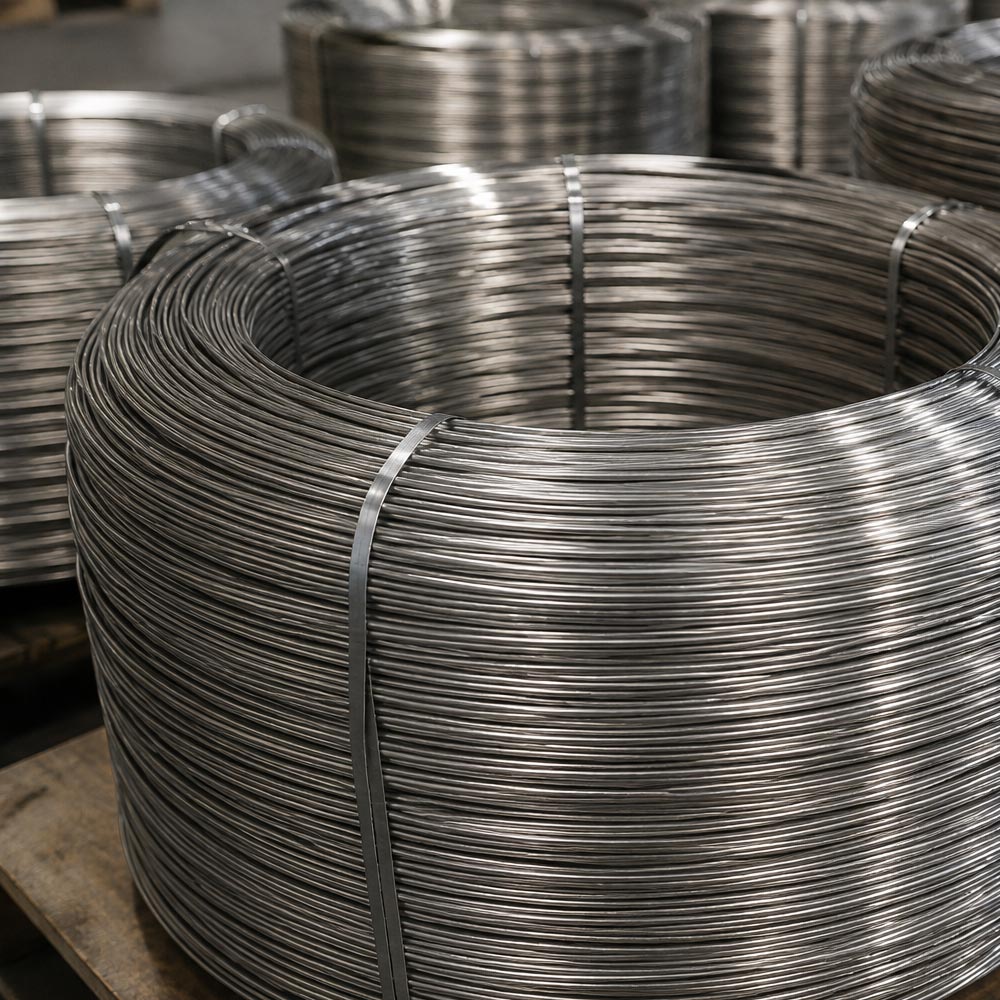
Stainless steel wire is a solid metallic product manufactured by drawing stainless steel wire rod through progressively smaller dies until the required diameter, tolerance, surface finish and mechanical properties are achieved. It may be supplied in coils, spools, reels, carriers or straightened cut lengths.
Stainless steel wire is used for springs, fasteners, welding, wire mesh, filters, cables, ropes, cold-heading components, kitchenware, automotive parts, medical equipment and general fabrication. The correct wire must be selected by grade, diameter, condition, tensile strength, finish, coil weight and final manufacturing process.
Solitaire Steel & Engineering LLP, based in Khetwadi, Mumbai, India, supplies and exports stainless steel wires and wire coils in different grades, diameters, tempers, finishes and packaging forms. Application-specific requirements for springs, welding, cold heading, weaving, forming and general engineering can be reviewed against the required specification and quantity.
| Specification | Available Requirement |
| Product | Stainless steel wire, wire coils, wire rod and cut lengths |
| Cross-Section | Round, flat, square, rectangular or customised |
| Common Grades | 202, 304, 304L, 316, 316L, 310, 321, 430, 410 and application-specific grades |
| Special Grades | Duplex, super-duplex, precipitation-hardening and high-alloy grades subject to specification |
| Diameter | Standard and customised wire diameters |
| Condition | Annealed, bright annealed, cold-drawn, hard-drawn, spring temper or as specified |
| Surface Finish | Bright, matt, pickled, soap-coated, polished, copper-coated or welding finish |
| Supply Form | Coil, spool, reel, carrier, drum or straightened cut length |
| Coil Weight | According to wire diameter, application and handling requirement |
| Dimensional Tolerance | According to applicable specification or customer requirement |
| Testing | Chemical, tensile, hardness, bend, wrap, coil, cast and helix tests as applicable |
| Documentation | Material test certificate and additional inspection documents where required |
| Packing | Moisture-protected, export packing or application-specific packaging |
Availability depends on grade, diameter, tensile requirement, surface finish, coil size, standard and order quantity.
| Selection Factor | Stainless Steel Wire Rod | Stainless Steel Wire |
| Product Stage | Semi-finished starting material | Finished or further-processed drawn product |
| Typical Diameter | Generally larger | Reduced through wire drawing |
| Surface Condition | Hot-rolled, pickled or prepared for drawing | Bright, annealed, coated, polished or as specified |
| Dimensional Control | Suitable for further processing | Controlled for final application |
| Mechanical Properties | Intended for subsequent drawing | Specified according to application |
| Supply Form | Large coils | Coils, spools, reels or cut lengths |
| Common Use | Production of wire | Springs, fasteners, mesh, welding and forming |
A buyer requiring finished wire should not order “wire rod” unless the material will undergo further drawing or processing.
Annealed wire is supplied in a softened condition to improve ductility and ease of forming. It is commonly used for binding, weaving, general fabrication, wire mesh and components requiring bending or forming.
Bright wire is cold-drawn and supplied with a clean, smooth surface. It is used for visible products, fasteners, formed components, kitchenware and precision applications.
Spring wire is manufactured to controlled tensile strength, diameter, surface quality, cast and helix requirements. It is used for compression springs, tension springs, torsion springs, clips and retaining components.
Stainless steel welding wire is supplied with controlled chemical composition and feeding characteristics for MIG, TIG, submerged-arc or other approved welding processes. Welding wire must be ordered by filler classification rather than base-metal grade alone.
Cold-heading wire is processed for manufacturing screws, bolts, rivets, pins and other fasteners. Surface condition, spheroidisation where applicable, ductility and heading performance are important selection factors.
Weaving wire is used for wire mesh, screens, filters, conveyor belts and knitted-wire products. Diameter tolerance, surface finish and continuous coil length affect weaving performance.
Rope wire is manufactured for stranding into stainless steel wire ropes and cables. Tensile strength, torsion performance, coating and rope construction must be specified.
Flat, square, rectangular and profile wire is used for retaining rings, clips, filters, springs, seals and customised components.
Wire can be straightened and cut into specified lengths for pins, rods, welding, fasteners and formed components.
| Wire Type | Common Standard | Common Grades | Typical Applications |
| General-Purpose Wire | ASTM A580/A580M | 202, 304, 304L, 316, 316L, 410, 430 | Forming, fabrication and general components |
| Spring Wire | ASTM A313/A313M | 302, 304, 316, 17-7 PH and approved grades | Compression, tension and torsion springs |
| Cold-Heading Wire | ASTM A493/A493M | 304, 304L, 316, 316L and fastener grades | Screws, bolts, rivets and pins |
| Weaving and Knitting Wire | ASTM A478 | Chromium-nickel stainless grades | Mesh, screens, filters and knitted products |
| Wire-Rope Wire | ASTM A492 or applicable specification | Application-specific grades | Ropes, cables and lifting assemblies |
| Wire Strand | ASTM A368 or applicable specification | Application-specific grades | Strand and cable production |
| Free-Machining Wire | ASTM A581/A581M | Free-machining stainless grades | Small machined components |
| Welding Wire | AWS A5.9/A5.9M or applicable specification | ER308L, ER309L, ER316L, ER347 and others | MIG, TIG and welding processes |
| Flat and Shaped Wire | Applicable ASTM, EN or customer specification | Grade as required | Clips, rings, filters and precision components |
| Cut-Length Wire | Applicable wire specification | Grade as required | Pins, forming, welding and general fabrication |
The applicable standard must be selected according to the wire’s final use. ASTM A580 general-purpose wire should not automatically be substituted for spring, welding, rope or cold-heading wire.
| Grade | Key Characteristics | Common Wire Applications |
| 202 | Good strength and economical for mild environments | General-purpose wire, forming and indoor components |
| 302 | High work-hardening response | Springs, clips and formed components |
| 304 | General corrosion resistance and broad availability | Mesh, springs, fasteners and fabrication |
| 304L | Lower carbon for welded components | Welding, forming and fabricated wire products |
| 316 | Improved chloride resistance compared with 304 | Marine-related fittings, mesh and industrial components |
| 316L | Low carbon with molybdenum | Welding wire, filters and chemical-processing components |
| 310/310S | Oxidation resistance at elevated temperatures | Furnace baskets, heat-resistant mesh and components |
| 321 | Titanium-stabilised for elevated-temperature service | Heat-resistant wire products and welding applications |
| 347 | Niobium-stabilised grade | Welding consumables and high-temperature components |
| 410 | Martensitic grade with higher strength | Fasteners, pins and heat-treated components |
| 430 | Ferritic, magnetic stainless steel | Appliance, automotive and general-purpose components |
| 17-7 PH | High-strength precipitation-hardening grade | High-performance springs and clips |
| 2205 Duplex | Higher strength and chloride resistance | Specialised chemical and marine-related wire products |
Not every grade is routinely available in every diameter, temper, finish or wire specification.
| Standard | General Coverage |
| ASTM A555/A555M | General requirements for stainless steel wire and wire rods |
| ASTM A580/A580M | General stainless steel wire |
| ASTM A313/A313M | Stainless steel spring wire |
| ASTM A478 | Chromium-nickel stainless steel weaving and knitting wire |
| ASTM A493/A493M | Stainless steel wire and wire rod for cold heading and cold forging |
| ASTM A492 | Stainless steel rope wire |
| ASTM A368 | Stainless steel wire strand |
| ASTM A581/A581M | Free-machining stainless steel wire and wire rods |
| AWS A5.9/A5.9M | Bare stainless steel welding electrodes and rods |
| EN 10270-3 | Stainless steel spring wire |
| EN 10088 | Stainless steel grades and applicable product requirements |
| Customer Specification | Application-controlled chemistry, tensile, finish and packaging |
The latest applicable edition and supplementary requirements should be stated in the purchase order.
| Condition | Characteristics and Common Use |
| Soft Annealed | High ductility for bending, tying and forming |
| Bright Annealed | Soft condition with a clean, bright surface |
| Quarter Hard | Increased strength with useful formability |
| Half Hard | Higher strength for clips and formed parts |
| Three-Quarter Hard | Higher tensile strength with reduced ductility |
| Full Hard | High strength for demanding formed components |
| Spring Temper | Controlled tensile strength for spring manufacture |
| Hard Drawn | Strength increased by cold drawing |
| Soap Coated | Improved lubrication for further drawing or cold heading |
| Pickled | Scale removed for further processing |
| Stress Relieved | Applied to specified spring or formed-wire requirements |
Terms such as “soft,” “hard” or “spring temper” should be supported by a required tensile-strength range wherever possible.
| Finish or Coating | Common Purpose |
| Bright Drawn | Clean appearance and controlled surface |
| Matt Finish | General industrial use |
| Bright Annealed | Clean, smooth surface with soft condition |
| Pickled Finish | Preparation for further drawing or processing |
| Soap Coated | Drawing and cold-heading lubrication |
| Nickel Coated | Selected welding and special applications |
| Copper Coated | Selected welding-wire feeding requirements |
| Polished Finish | Decorative and precision applications |
| Passivated | Improved surface cleanliness and passive-film condition |
| Custom Lubricant | Application-specific forming or heading process |
The selected lubricant or coating must be compatible with the buyer’s forming, welding, cleaning and final-use requirements.
Wire performance cannot be defined by grade and diameter alone. Buyers should specify:
For spring wire, tensile strength normally changes with diameter. One tensile value should not be applied to every wire diameter without checking the governing specification.
Cast and helix affect how wire feeds, straightens and behaves during automated production.
These requirements are important for:
Buyers using automatic equipment should specify acceptable cast and helix limits.
| Packaging Form | Common Use |
| Loose Coil | General fabrication and manual handling |
| Compact Coil | Controlled handling and storage |
| Spool | Fine wire and machine feeding |
| Reel | Continuous wire processing |
| Carrier | High-volume production |
| Drum Pack | Automated welding or continuous feeding |
| Pay-Off Pack | Controlled high-speed unwinding |
| Straightened Cut Length | Pins, rods, electrodes and forming |
The buyer should specify internal diameter, external diameter, coil width, maximum coil weight and pay-off direction where these affect equipment compatibility.
| Buyer Requirement | Important Selection Factor |
| Binding and tying | Soft-annealed condition and suitable ductility |
| Spring manufacturing | ASTM A313, tensile range, cast and helix |
| Screw and rivet production | Cold-heading quality, surface coating and ductility |
| Wire mesh | Diameter tolerance, finish and continuous coil length |
| Welding | Correct AWS filler classification and feeding package |
| Marine-related use | Suitable molybdenum-bearing or approved grade |
| High-temperature mesh | 310S, 321 or another approved heat-resistant grade |
| Food equipment | Grade, surface cleanliness and applicable hygienic requirements |
| Automated forming | Controlled cast, helix, coil set and spool dimensions |
| Precision cut lengths | Diameter, length, straightness and end condition |
The price of stainless steel wire and wire coils depends on:
Fine-diameter, tight-tolerance, spring-quality and specialised welding wires generally require more processing than standard annealed wire.
For an accurate technical and commercial quotation, please provide:
❝
For a quotation for stainless steel wire, wire coils, spring wire, welding wire, cold-heading wire, weaving wire or straightened cut lengths, contact Solitaire Steel & Engineering LLP. Our team will review the required grade, standard, diameter, tensile condition, finish, packaging, quantity and delivery location before confirming availability and pricing.
❞